Katolsk

FSSPs sogneprest i Roma sier

Fr Kramer (i videoen) sier bl.a.:

… A large segment of Father Kramer’s flock is people born decades after the Tridentine Mass ceased to be the norm. He says they are frequently drawn by the older liturgy’s emphasis on the sacrificial dimension, which makes it «more obvious that Christ is pouring out his blood for the forgiveness of sins.»

The 59-year old priest says that Catholic clergy of his generation, reacting to the severe moralizing that prevailed before Vatican II, were «very reluctant to talk about the punishments for sin.» But the «new generation,» recoiling from the more libertine mores with which it grew up, «needs to talk about sin and how the problem of sin is resolved,» he said.

Younger people also are «more sophisticated than they used to be, and they’re looking for something at a higher level,» Father Kramer says. «And I think that is connected with finding the great tradition and richness of the last 2,000 years.» …

Jeg fant innlegget på Rorate cæli (mange kommentarer også der) og teksten på CNS.

Dagens Ratzinger-sitat

Fra Father Z’s blogg (les hele sitatet der):

In Co-Workers of the Truth: Meditations for Every Day of the Year, from the works Joseph Ratzinger for 25 April we read a blurb from his perennially useful Feast of Faith:

“The Council did not create new articles of faith, nor did it replace existing ones with new ones. Its only concern was to make it possible to hold the same faith under different circumstances, to revitalize it. … many of the documents (of the Council) were issued too abruptly. To many of the faithful, most of them seemed to be a challenge to the creativity of the individual congregation, in which separate groups constructed their own “liturgies” from week to week with a zeal that was as commendable as it was misplaced. To me, the most serious element in all this was the breach of fundamental, liturgical consciousness. The difference between liturgy and festivity, between liturgy and social event, disappeared gradually and imperceptibly, as witness the fact that many priests, imitating the etiquette of polite society, feel that they ought not to receive Holy Communion until the congregation has received; that they should no longer venture to say “I bless you” [German euch: familiar form of plural “you”]—thus dissolving the fundamental liturgical relationship between them and their congregation. … In the period before the new missal made its appearance, but after the old one had already been characterized as “old-fashioned”, people forgot that there is a “rite”, that is, a prescribed liturgical form, and that liturgy is genuinely liturgy only if it is not subject to the will of those who celebrate it.”

Katolske nonner i USA – er man slemme med dem?

Jeg har fått flere e-poster de siste dagene som referer til artikler i ikke-kirkelige aviser som viser til hvor slemme Kirken har vært mot nonnene i USA. Den siste e-posten viser til en artikkel i The New York Review of Books som kalles «Bullying the Nuns«.

Men Fr. Z. skriver følgende om dette, og kommer med en rekke eksempler:

The Holy See and USCCB are aiming their reforms at the leadership of the liberal umbrella group the LCWR (a subsidiary of the Magisterium of Nuns). The Catholic hierarchy is not attacking nuns or sisters. Don’t be fooled by twisted news coverage on catholic and secular sites. …

Snart 50 år siden Vatikankonsilet

I en artikkel i FirstThings, The Serenity of Vatican II, leser vi:

It has now been almost fifty years since the Catholic Church created waves by opening the Second Vatican Council. And for many, the tumult continues. Vatican II has become nothing less than a battle over the mission of the contemporary Church.

William Doino Jr. The progressive left sees the Council as an open-ended innovation whose revolutionary promise has yet to be fulfilled. The traditionalist right views it with deep suspicion and is sometimes heard to say (if not openly, at least sotto voce) that the Church would have been better off had it never occurred. …

Så fortsetter denne artikkelen ganske tradisjonelt (på en måte) å beskrive hva som skjedde etter konsilet etc. Men informasjon om pave Johannes XXIII var mer ukjent for meg:

… Pope John XXIII’s famously jovial personality has led many to believe he was an unabashed progressive, and this has colored many accounts of the Council. But Molinari, a close friend of the pope, told me that this popular image of “Good Pope John” as easygoing and tolerant of almost any proposal, is “absolute nonsense.” Finally, statistics about the Church in the pre-Conciliar years are misleading, because there were many trends afoot—in theology, morality, politics, science, and exegesis—that were already having an unsettling impact on the internal life of Catholics.

At the end of our discussion, I still had one question: “All that being said Father, and granting the necessity, beauty, and orthodoxy of the Council’s teachings—how did their implementation go so disastrously wrong in the immediate years that followed?”

“The Council called us to find fulfillment in Christ,” he said gently, “but many Catholics confused that with their own self-fulfillment.” Stunned, I finally murmured, “That’s a pretty big mistake.” “Yes,” he replied, with tremendous understatement. …

Spenninger i Kirken – og pave Benedikts ledelse

En engelsk katolsk sognepreest, Fr. Ray Blake, skriver om hva som skjer i Kirken for tiden. At det stadig blir tydeligere hvem som motsetter seg pave Benedikts reformplaner, som riktignok gjennomføres langsomt og forsiktig, gjennom pavens eksempel og undervisning, men som likevel har en tdelig retning:

So the SSPX are likely to be in soon. Already the Ordinariate is beginning to thrive in the States, and once they are given a church or two here that might happen in England and Wales – though they are doing pretty well using Spanish Place as their «Cathedral». Those with a Catholic «sense» are given courage to live out their faith. The liberation Summorum Pontificum gave the Traditional usage is slowly making an in road into the Church and parish life. Seminaries are gradually becoming more Catholic, even if they are not, they are turning out young priests who want authentic Catholicism.
and yet; Those American nuns who have «moved beyond Jesus» are likely to be out, at least as an organisation but there very presence shows how deep the rot goes. Dissident Irish priests have been silenced but in Ireland dissidence seems to be the new orthodoxy. In Austria there is open disobedience and rather dubious decisions made by some of the hierarchy. In the US the Bishops are fighting off the government and perhaps wondering whether they have much backing from the ordinary Catholic in the pew.

…. Seven years ago many were expecting a «rottweiler» Pope, who would clear up doctrinal error, boot out heretical bishops, cleanse the Curia, clamp-down on liturgical abuses and theological errors and those peddling them. Instead we have had a Pope who teaches. His teaching however is constantly radical, a continual call out of the confused disunity of darkness into the light of Christ. Yet he is criticised for not using his authority to clean up the Church. How often does one hear amongst Roman dicastery officials the criticism, «he reigns but does not rule»?

What we have in the Church is increased division, and it is the Pope himself who is the source of division. There is an increased seperation between those who gather with Peter and those who don’t. …

Cardinal Koch recently said: «A widespread criticism holds that the pope is not concerned» about the church as a whole but is focused on a small portion of his flock and «is content with that». «The only thing that is true in this criticism is that, in reality, the pope is convinced that the true renewal of the church cannot begin with the masses, but only with small movements» inspired by the Holy Spirit and acting as leaven for the rest of the church, the cardinal said.

Troskongregasjonen irettesetter katolske nonner

Jeg er tre dager for seint ute med å rapportere at Troskongregasjonen denne uka offentliggjorde en rapport der de sterkt kritiserer LCWR (Leadership of Catholic Women Religious) – den organisasjonen som organiserer ca. 80% av katolske ordenssøstre i USA. Det danske nettstedet Katolsk Tradition skriver om dette:

… Troslærekongregationen har netop offentliggjort en doktrinær undersøgelse af organisationen. Man kan heri erfare, at organisationens møder og publikationer regelmæssigt indeholder budskaber, som er i åbenlys modstrid med de mest basale dele af Kirkens lære, og så er der naturligvis den udbredte forvirring omkring seksualmoral og kvindens stilling i Kirken. … I rapporten hedder det bl.a.:

1) Den nuværende læremæssige og pastorale situation i LCWR er kritisk og giver anledning til alvorlig bekymring, givet den indflydelse,som LCWR har på ordenssamfund også i andre dele af verden;

2) Så snart den igangværende visitation af de kvindelige ordner i USA er afsluttet, skal den hellige Stol gribe ind for at gøre hvad der er nødvendigt for at reformere LCWR;

3) Troslærekongregationen vil undersøge forskellige muligheder for kanonisk indgriben mhp. at afhjælpe de problemer som findes i LCWR.

Enhver med blot en smule kendskab til romerske skrivelser vil forstå, at der her tales med meget store bogstaver. ….

Den amerikanske bispekonferansens nettsider skriver også om dette, og har også en lenke til selve rapporten til Troskongregasjonen HER (pdf-fil).

Father Z. skrev om dette for noen få dager siden. Også det ganske liberale katolske tidsskriftet America melder om dette – med en nokså nøytral presentasjon, men kommentarene viser hvem som leser dette bladet.

Eksempel på fornyelse av klosterlivet – og hele Kirken

Videoen under viser at det er stor tilstrømning til enkelte tradisjonelle ordenssamfunn i USA; og noen antyder at dette viser til en generell fornyelse av hele Kirken. (Til de som kjenner den tradisjonelle messen: Legg merke til at også novisene (som ikke er ikledd) dekker til hodet i kirken.)

Forsoning med SSPX? – fra katolsk.no

katolsk.no lenker til denne videoen og skriver også:

… Spekulasjonene om en eventuell forsoning er nå mange, og vatikaneksperten Andrea Tornielli hevder at biskop Fellay har akseptert løsningsforslaget, noe som åpner for full forsoning med Vatikanet etter mer enn tre års forhandlinger.

Svaret fra SSPX vil nå behandles av den pavelige kommisjonen Ecclesia Dei, som sammen med Troskongregasjonen har forhandlet med St. Pius X-selskapet.

John Allen skrev også om dette i går.

Pave Benedikts fødselsdag i går

I går (16. april) fylte pave Benedikt 85 år. Jeg føyer meg også til gratulantene, og tar med noe av hva danske ‘Katolsk orientering’ skriver om fødselsdagen:

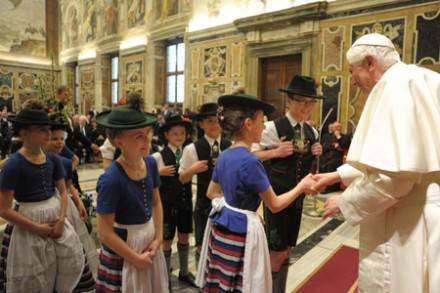
Pave Benedikt XVI fejrede sin 85-års fødselsdag mandag den 16. april sammen med gæster, der opvartede ham med bayersk ’oompah’-musik og folkedans i Den apostoliske Palads.

Tidligere på dagen sagde paven i en improviseret prædiken: “Jeg befinder mig på sidste stykke af min livsrejse og jeg ved ikke, hvad der venter mig”.

“Dog ved jeg, at Guds lys eksisterer, at han er opstanden, at hans lys er stærkere end ethvert mørke, og at Guds godhed er stærkere end alle verdens onder, og det hjælper mig til at fortsætte fremad med vished”, sagde han.

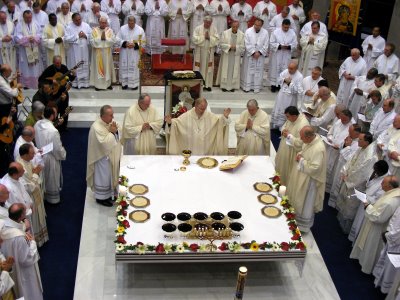
De nuværende biskopper i Bayern, delstatens ministerpræsident Horst Seehofer og en delegation på omkring 150 personer besøgte paven i Det clementinske Kapel i Vatikanet. …

Bildet under viser noen av de besøkende fra Bayern.

Hvilken vei skal presten vende seg?

Una Voce har skrevet flere artikler om liturgiske spørsmål som de har samlet på denne siden. De skriver:

While the Holy Father makes reference to two areas of possible change to the 1962 books, new Saints and Prefaces, debate about the future of these liturgical books is not limited to those matters. For that reason, and also because of the first mentioned purpose of these papers, we will be addressing topics on a wide range of issues. As well as an introductory paper, giving something of a disclaimer about our remit, the first six topics planned are:

Introduction
The Service of Men and Boys at the Altar
Liturgical Piety and Participation
The Manner of Receiving Communion
(The Vulgate and Gallican Psalter)
Liturgical Orientation
(Holy Week)

De to i parentes over er ikke ferdige, og nå nylig er en artikkelen om liturgisk orientering klar (pdf-fil her), en artikkel som har følgende oppsummering (og som jeg kommer til å dekke litt gundigere om ikke lenge):

The celebration of Mass ad orientem (towards the East, away from the people) is a very visible difference between the Extraordinary Form and most celebrations of the Ordinary Form of the Roman Rite. Celebration versus populum was known in the early centuries, and in certain churches later (notably, St Peter’s Basilica in Rome), but celebration ad orientem was more common, and in any case the value of the practice cannot be determined solely by ancient practice. Rather, as Pope Benedict has argued, celebration ad orientem emphasises both the escatalogical nature of the liturgy, and the common orientation of priest and people towards the Lord, as opposed to an excessive focus by the Faithful on the celebrating priest (and vice versa). It also emphasises the sacrificial nature of the Mass. In all these ways it is central to the character and value of the Extraordinary Form as a whole.

Michael Voris om den tradisjonelle latinske messen

Han er veldig amerikansk og litt provoserende i stilen (så noen bør kanskje holde seg unna), men her sier Michael Voris at typisk for svært mange av de stedene han og hans organisasjon har besøkt det siste halvåret, har fokuset vært på den tradisjonelle latinske messen. Han selv har ikke særlig lenge kjent til denne liturgiske tradisjonen, men han blir imponert over at mange grupper som kjemper tydelig og aktivt for katolsk tro og katolsk identitet, samler seg rundt den tradisjonelle messen. Det er spesielt tydelig at unge menn tiltrekkes av denne messen. Se videoen under om du vil.

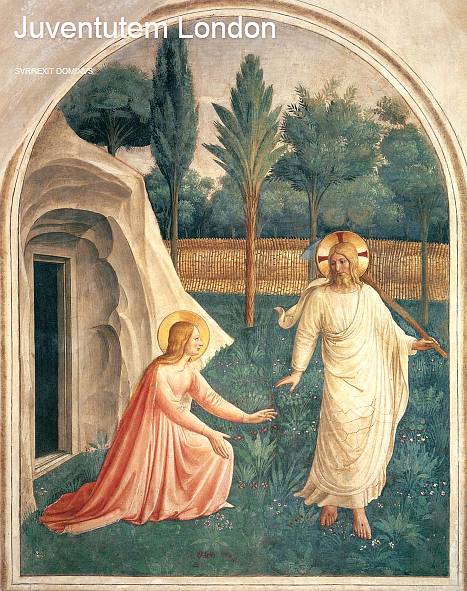
Én av gruppene han nevner spesielt er Juventutem – her er en lenke til deres gruppe i London.

Forsoning med SSPX?

I morgen er fristen SSPX ble gitt for en måned siden til å gi svar på flere teologiske spørsmål fra Vatikanet. Der har derfor blitt skrevet mye om temaet de siste dagene. Noen tviler på at man kan komme til enhet, men bl.a. det kjente svenske katolske tidsskiftet Signum skriver i dag:

… Under det senaste dygnet har dock flera italienska tidningar, exempelvis La Stampa, meddelat att Vatikanen nu mottagit ett nytt skriftligt ställningstagande från SSPX:s ledare Bernard Fellay. Och den franska dagstidningen Le Figaro uppger att en försoning är omedelbart förestående, och att man lyckats formulera ett gemensamt dokument om betingelserna för en försoning som båda parter är beredda att underteckna.

Enligt uppgifter skulle SSPX få en kyrkorättslig status liknande en så kallad personalprelatur och komma att stå direkt under påven, inte under de lokala stiftsbiskoparna.

Ännu finns inga officiella kommentarer vare sig från Vatikanen eller från SSPX, men de lär komma inom kort.

Artikkelen i Le Figaro (som det refereres til) har Rorate cæli skrevet en del om her.

Den neokatekumenale veis messefeiring


Bildet over sjokkerer meg ganske mye, og jeg kan ikke forstå at noen ønsker å feire det katolske messeofferet på en slik måte. Fr. Finigan skriver om den neokatekumenale vei – og jeg er enig med ham; jeg møtte selv flere flotte medlemmer i organisasjonen da jeg var i England 1997-98:

… I have great admiration for the apostolic and evangelical zeal of the members of the Neocatechumenate. I am not particularly moved by arguments about them forming an «elite.» Any group that ever did anything useful in the Church by way of apostolate was to some degree exclusive – this means nothing really much more than gathering an effective group together with a common purpose for the good. There have been many priestly vocations, in some cases reviving whole dioceses; in addition, the generosity of families in following the moral teaching of the Church is a fine example to others.

However the Liturgy does look in need of major overhaul. This problem is not confined to the Neocatechumenate. Many of the new movements encouraged by Blessed John Paul have remained stuck in a 70s-80s time warp with regard to their liturgy and find it difficult to adapt to the new situation created by Pope Benedict’s Summorum Pontificum. …

Men mest av alt er det en artikkel hos www.chiesa, som har satt denne saken på dagsordenen denne uka. Og katolsk.no nevner det også i dag.

3 500 voksne ble døpt i Hong Kong i påsken

Jeg tar med denne gladnyheten fra AsiaNews:

3500 adults receive baptism at Easter Vigil. Card. Tong thanks the catechists

There are 39 paid catechists and 1500 volunteer catechists. Evangelization a pastoral priority for Card. Tong. The story of Janet, who will be baptized tonight, along with her younger brother.

Hong Kong (AsiaNews) – This Easter, 3,500adult catechumens in the Hong Kong diocese will receive the Sacrament of Christian Initiation (Baptism, Confirmation and Holy Communion) at various parishes at the Holy Saturday Vigil today, April 7.

In his Easter Pastoral Letter 2012, Cardinal John Tong of Hong Kong specially thanks priests, deacons, sisters and laypeople to offer their time and energy in teaching catechism. The catechists «not only carry out the mission of evangelization of the Church, but also strengthen their own faith,» the 72-year-old bishop said. …..

Det var også kardinal Tong som feiret 10 års-jubileet fra den tradisjonelle messen i Hong Kong som jeg skrev om i går.

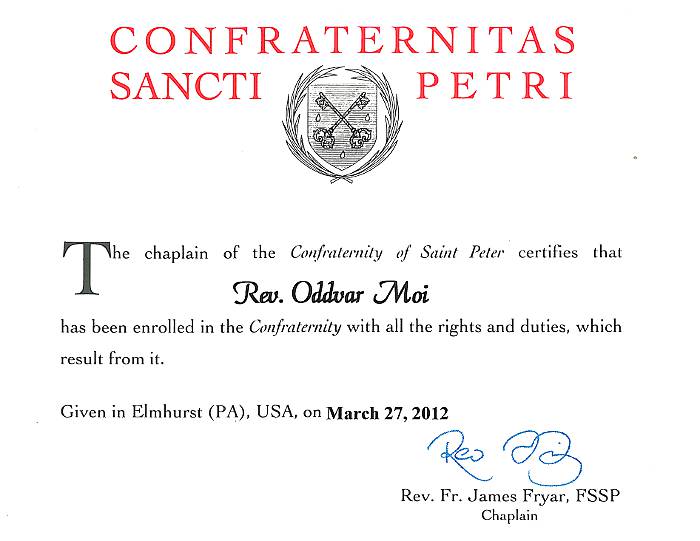
Konfraterniteten for den hellige Peter

Jeg mottok for snart en uke siden medlemsbeviset i Konfraterniteten for den hellige Peter (FSSPs støttegruppe) – se det under:

I brevet som fulgte med står det følgende om pliktene medlemsskapet fører med seg:

Your obligations as a member of the Confraternity are threefold:
1. To offer one decade of the rosary each day for the intentions of the Confraternity,
2. To recite the prayer of the Confraternity each day
3. To have the Holy Sacrifice of the Mass offered once each year for the intentions of the Confraternity

The intentions of the Confraternity are the following:
1. The sanctification of the members of the Priestly Fraternity of St Peter
2. For vocations to the Fraternity
3. For the fruitfulness of the Fraternity’s apostolic labors.

Man får så igjen følgende goder:

In return for these obligations of your charity, you will enjoy the benefits of the prayers that the Priests and Seminarians will offer for you on a daily basis. Also, once a month the Holy Sacrifice will be offered for the Confraternity members of each region by their respective Chaplains. There are conferences, printed matter, days of recollection pilgrimages and retreats provided for the spiritual advancement of the members of the Confraternity.

The Holy See has granted the following indulgences for the members of the Confraternity:

1. A plenary indulgence:
a) On the day of their admission into the Confraternity;
b) On February 22nd, Feast of the Chair of St Peter and anniversary of the foundation of the Confraternity;
c) On June 29th, Feast of Saints Peter and Paul;

2. A partial indulgence:
Whenever they partake in pious or charitable activities as members of the Confraternity.

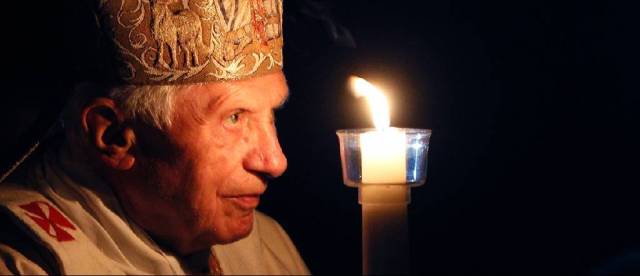
Fint bilde av pave Benedikt påskenatt

Bildet over er fra Vårt Land, og de bruker en NTB-artikkel som bl.a. sier:

I dag kan vi lyse opp våre byer så strålende at stjernene på himmelen ikke lenger er synlige. Er ikke det et bilde på problemene som har oppstått som følge av vår versjon av opplysning, spurte Benedikt under kveldens feiring påskeaften.

…. I prekenen sin sa paven, som ofte har snakket om miljøet, at de utrolige vitenskapelige triumfene som er oppnådd, ikke bare er framgang, men også setter både menneskeheten og verden i fare.

Pave Benedikt om prestenes lydighet


Pave Benedikt var svært så tydelig i går i sin preken under oljevigselsmessen i Peterskirken, da han snakket om prestenes oppgaver og lydighet, rett før prestene jadde sin årlige fornyelse av presteløftene. Han snakket både om lydighet (og et eksempel på ulydighet fra Østerrike), om mangel på skikkelig katekese flere steder, og sist snakket han om prestene hadde et sterkt ønske om sjelenes frelse som basis for sin tjeneste. Her er et lite utdrag som handler mest om lydighet/ulydighet:

…. But does our consecration extend to the daily reality of our lives – do we operate as men of God in fellowship with Jesus Christ? This question places the Lord before us and us before him. “Are you resolved to be more united with the Lord Jesus and more closely conformed to him, denying yourselves and confirming those promises about sacred duties towards Christ’s Church which, prompted by love of him, you willingly and joyfully pledged on the day of your priestly ordination?” After this homily, I shall be addressing that question to each of you here and to myself as well. Two things, above all, are asked of us: there is a need for an interior bond, a configuration to Christ, and at the same time there has to be a transcending of ourselves, a renunciation of what is simply our own, of the much-vaunted self-fulfilment. We need, I need, not to claim my life as my own, but to place it at the disposal of another – of Christ. I should be asking not what I stand to gain, but what I can give for him and so for others. Or to put it more specifically, this configuration to Christ, who came not to be served but to serve, who does not take, but rather gives – what form does it take in the often dramatic situation of the Church today? Recently a group of priests from a European country issued a summons to disobedience, and at the same time gave concrete examples of the forms this disobedience might take, even to the point of disregarding definitive decisions of the Church’s Magisterium, such as the question of women’s ordination, for which Blessed Pope John Paul II stated irrevocably that the Church has received no authority from the Lord. Is disobedience a path of renewal for the Church? We would like to believe that the authors of this summons are motivated by concern for the Church, that they are convinced that the slow pace of institutions has to be overcome by drastic measures, in order to open up new paths and to bring the Church up to date. But is disobedience really a way to do this? Do we sense here anything of that configuration to Christ which is the precondition for all true renewal, or do we merely sense a desperate push to do something to change the Church in accordance with one’s own preferences and ideas? …

Les hele prekenen her.

Er messen et offer eller et måltidsfelleskap?

Jeg har skrevet om dette mange ganger før, men tar med et lett-å-forstå innlegg om temaet av Fr. Longenecker. Han har forøvrig flyttet sin blogg for ikke lenge siden – les om det her. Han skriver at noen katolikker mener (men de tar feil):

…. the Mass is like the Last Supper when we all gather around Jesus in a fellowship meal! That’s why the priest should face the people–because it’s like we’re all sitting around the family dinner table with Jesus.”

It’s easy to see how this thinking came about, and within the “spirit of Vatican 2″ it’s not hard to draw the conclusion that the Mass is essentially a fellowship meal and a re-enactment of the Last Supper. However, this is not the case. …

… The Mass of the Lord’s Supper is the one commemoration of the Lord’s Supper in the liturgical year. The regular daily and weekly masses, while they may echo the Last Supper, are not primarily a commemoration of the Last Supper. The Mass is first and foremost a commemoration of Calvary. Through the holy sacrifice of the Mass the one, full, final sacrifice of Christ, both priest and victim, is brought into the present moment and it’s eternal benefits are applied to our needs here and now.

When we go to Mass therefore, we stand at the foot of the cross, we do not sit down with Jesus at the Last Supper. To be sure, the Mass is a “fellowship meal” but it is a ritual meal into which the Jewish Passover is echoed and the sacrifice of Calvary is made present. The Last Supper was the bridge between these two–a bridge between the Passover and the death of Christ the Lord.

Why does this matter? For several reasons: first of all, if the Mass is a fellowship meal it is easy to forget the importance of the sacrifice of Our Lord. Is it any mistake that in Catholic churches where the emphasis is on the fellowship meal that the crucifix is often small in size, relegated to a side position, replaced with a resurrected Lord or absent completely?

When the emphasis is on the fellowship meal too often the emphasis of worship shifts from Christ the Lord and his once for all sacrifice for the sins of the world and moves to us, our fellowship, our feelings …

Finally, the shift to fellowship meal rather than the sacrifice of the Mass reduces the sense of reverence. If it is all about us and our community then what is the need for reverence in worship? If it is a fellowship meal the church becomes our house not God’s temple. The mood is therefore one of the campfire, the shared picnic or the family reunion.

The ironic thing is, that when we focus on the sacrifice of the Mass we, in the end, get the fellowship we desire as well. As we face the altar together we are drawn togethers. As we focus on the same eternal beloved we come to regard one another as beloved. As we move to the same destination we also move closer to one another. Like lines from different starting points converging we come together in a mystical communion which is far more profound and eternal than an enjoyable, but earthly fellowship.
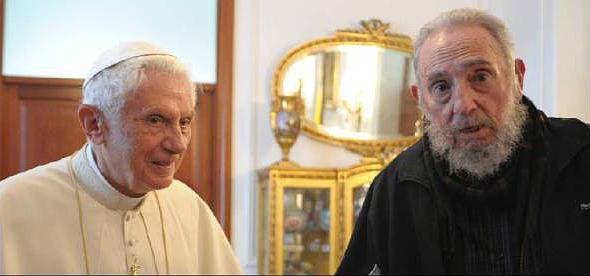
Langfredag blir igjen helligdag på Cuba


Vårt Land melder at pave Benedikts forespørsel om at Cuba på nytt gjør Langfredag (ikke påskedag, som noen har skrevet; søndager er jo helligdag de fleste steder allerede) til helligdag raskt er blitt besvart:

… Ønsket har nå blitt innvilget av cubanske myndigheter.

Det betyr at cubanere for første gang siden revolusjonen i 1959 får fri på langfredag.

– Jeg er glad for at jeg slipper å jobbe, men forstår egentlig svært lite av alt sammen, sier Roberto Blanco til nyhetsbyrået AP.

Skroll til toppen