Katolsk

Pave Frans’ liturgiske revolusjon

I et interessant innlegg på PrayTell-bloggen skriver Fr Anthony Ruff, OSB, om en mulig liturgisk revolusjon – mange er i alle fall usikre på hvordan pave Frans’ liturgi kommer til å utvikle seg. Fr Ruff åpner med å si at han har laget en «list of what Pope Francis has done with ceremonial and ritual. It’s been quite a ride since his election!» Og han avslutter innlegget slik:

…. Some of us are (to use necessary but sometime unhelpful labels) rather “traditional” when it comes to liturgy. I always follow the book when I celebrate, including all the genuflections. I’ve increased considerably the amount of Latin chant at St. John’s Abbey, eg. including four Latin Mass ordinaries (rather than one) in our choir stall binders in conjunction with implementation of the new English Missal. I pushed for (and got) incense at Mass every Sunday when the new Missal came. I was about to push for a dress code for readers and other liturgical ministers (no jeans, etc.) in our School of Theology•Seminary, until this new pope came along and my case got weakened.

As much as I appreciate the pope’s simpler style and his throwing overboard all these archaic and irrelevant signs of monarchical and aristocratic power, I admit to mixed feelings about it all. Simplicity is good, but tackiness isn’t. Will that be the unfortunate consequence of his liturgical revolution? Will there be an aesthetic price?
Pope Benedict put before us the importance of beauty in the church’s life. Alas, his style of celebrating the liturgy, as beautiful as it was, had a rather narrow notion of beauty. It was too Eurocentric, too archaic, too fussy and precious, too aristocratic, too clericalist. I fear that not much of his vision will last. And that’s a shame. In my ideal world, we would draw on Pope Benedict’s inspiration as we find new ways to integrate the artistic riches of our heritage into the very changed conditions of the world we live in.

I also wonder whether Pope Francis isn’t doing too much all at once. Is this hurting some people’s feelings? (Yes, judging from the blogosphere.) Is it confusing some people? (Yes, judging from my conversation with theology students, including some I wouldn’t call “conservative.”) I hope Pope Francis proves to be a uniter and not a divider.

That’s my prayer. Pope St. Pius V, pray for us.

St Olav tidsskrift skriver om pave Benedikt

13mars_stolav_tids2

St Olavs redaktør, Heidi Øyma, skriver en grundig og interessant lederartikkel om pave Benedikt i siste nummer av tidsskriftet (les det her), artikkelen begynner slik:

Det er ikke lett å sammenfatte pave Benedikts rikholdige pontifikat – så mye på bare åtte år! Heldigvis har han selv gitt oss tolkningsnøkkelen.

«Biskopen av Roma sitter på sin bispestol for å vitne om Kristus». Den nyvalgte pave Benedikt uttalte dette under sin høytidelige innsettelse på bispestolen i Romas katedral, Laterankirken. Det er umulig å forstå Benedikt XVI hvis man ikke tar utgangspunkt i de to store temaene i hans liv: kjærligheten til Kristus og kjærligheten til Kirken. Det er en kjærlighet som ikke har gjort blind, men tvert imot gitt ham et forbausende klarsyn – en realisme som også er født av dyp ydmykhet.

Josef Ratzinger deltok med stor begeistring på Det annet vatikankonsil og formidlet underveis til katolikker i hjemlandet hva Konsilet betød. Etter kirkemøtets første sesjon holdt han i januar 1963 et langt foredrag på universitetet i Bonn. Han avslutter sin entusiastiske og skarpsindige analyse av konsilarbeidene med to bemerkninger om hva Konsilet aldri vil kunne gjøre. Den første av dem lyder: «Konsilet kan ikke eliminere Kirkens menneskelige natur. Selv etter Konsilet vil denne naturen ha behov for fornyelse. Den vil vare helt til Herrens gjenkomst.»

Femti år senere lyder dette som profetiske ord, særlig når man tenker på den euforiske stemningen og nesten grenseløse optimismen som hersket i Kirken da de ble uttalt, en tro på at (til dels høyst påkrevde!) reformer skulle bety en slags endelig løsning på alle vanskeligheter. …

Lederartikkelen er ganske lang, så her hopper jeg over en hel del, og tar med avslutningen:

Pave Benedikts beslutning, som han tok «etter gjentatte ganger å ha ransaket min samvittighet fremfor Gud», er også et resultat av hans realisme og ydmykhet, samt åpenhet for ukonvensjonelle valg så sant de er i samsvar med sannheten. Den utløste en medieinteresse uten like. Blant de tidlige kommentarene kunne vi ofte lese at katolikkene og Kirken nå var «rystet». Det pussige var at det var utrolig vanskelig å finne en katolikk som faktisk ga uttrykk for rystelse. Vemodige, ja, med en følelse av «faderløshet», som biskop Eidsvig uttrykte det i takksigelsesmessen for Benedikts pontifikat, jo, absolutt. Noen satt også med en opplevelse av at paven kanskje ikke hadde handlet rett. Men rystet? Nei. Hvorfor i all verden skulle vi være det?

Mye som ble sagt i dagene mellom annonseringen av Benedikts avgang og valget av en ny pave, tyder på at media ironisk nok langt overvurderer pavens betydning. Benedikt gjør ikke det. I sin selvbiografi beskriver han levende det overdådige oppbudet i hjembyen da han og storebroren kom hjem for å feire sine første hellige messer. Han gikk der og hørte på jubelen og sa til seg selv: «Dette er ikke til ære for deg, Josef, det er ikke til ære for deg.»

Kirkens glede over en nyviet prest eller over en nyvalgt pave eller æresbevisninger for en pave som går av, skyldes ikke personen selv, men ham som er Kirkens Herre. Derfor kunne Benedikt etter å ha mottatt en langvarig applaus fra kardinalene og de fremmøtte – en applaus han vanligvis ville avbrutt, men denne gangen ga rom for – si takk for deretter å konkludere: «La oss vende tilbake til bønnen.»

… Igjen og igjen under sine siste dager på Peters stol understreket pave Benedikt at Kirken ikke tilhører oss – heller ikke tilhører hun paven – men Kristus, han som ikke svikter. Slik kan abdikasjonen også sees som en stor troshandling. Som paven sa det da han annonserte sin avgang: «Jeg takker dere hjertelig for den kjærlighet med hvilken dere har båret byrden av min tjeneste sammen med meg, og det arbeid dere har gjort. Jeg ber om tilgivelse for alle mine mangler. Nå betror vi Kirken til den øverste Hyrde, Vår Herre, Jesus Kristus.»

«Biskopen av Roma sitter på sin bispestol for å vitne om Kristus». Benedikt vitnet om Kirkens Herre ikke minst da han reiste seg fra stolen.

Bokanmeldelse i St Olav – av boken «Hellig uro»

I siste nummer av St Olav kirkeblad, som nettopp er lagt ut på nett, finn er vi en omtale av boken Hellig uro, Emilia forlag 2012, Per Kværne og Anne Helene Utgaard (red). Bokomtalen er skrevet av Olav Hovdelien. Beskrivelsen av boken begynner slik:

«Det er imidlertid vår overbevisning at det nettopp er gjennom uro, bevegelse, fornyelse og reform at kirkens vei mot marginalisering kan stanses og kirken igjen bli i stand til å forkynne Jesu glade budskap ikke bare for de ’praktiserende’, men for alle mennesker.»

Sitatet er hentet fra det innledende essayet i antologien Hellig uro. 50 år etter Det annet vatikankonsil, redigert av p. Per Kværne og Anne Helene Utgaard. Genremessig ligger antologien nærmest debattboken. I tillegg til innledningen består boken av til sammen ti essays, som alle i ulik grad og på ulike måter retter et kritisk søkelys på tilstanden i Den katolske kirke. Den grunnleggende påstanden er at Kirken «er i bevegelse bort fra konsilets intensjoner», og følgelig befinner seg i en dyp vedvarende krise. …

Hovdelien roser deler av boken, og har en viss forståelse for forfatternes synspunkter og idealer, men likevel skriver han også:

… Listen over alt som er galt med Kirken ifølge bidragsyterne til Hellig uro, er likevel lang som et vondt år. Medisinen som foreskrives er derfor en dyptgripende «modernisering» av Kirken nærmest på alle plan. Siden så å si alt det forfatterne hevder er galt med Den katolske kirke, er innført for eksempel i Den norske kirke, kunne konklusjonen fra forfatternes side vært slik: Den katolske kirke burde bli som Den norske! Hvorfor trekkes ikke denne opplagte konklusjonen i boken?

Kan det ha med det å gjøre at Den norske kirke, i likhet med andre liberale protestantiske kirker, har en betydelig større grad av sviktende oppslutning enn Den katolske? Det er ikke opplagt at «modernisering» er en vei ut av marginalisering (jf. sitatet øverst). ….

Samlet sett virker det som boken henvender seg til lesere som allerede i utgangspunktet deler forfatternes analyser. Den hadde blitt atskillig mer interessant og argumentativt troverdig hvis forfatterne ikke hadde vært fullt så sikre i sin sak og også hadde tatt seg bryet med å diskutere med dem som har alternative analyser å komme med.

George Weigel skriver om pave Frans

George Weigel er ikke hvem som helst (les om ham på Wikipedia , bl.a. om alle bøkene han har skrevet), og han skriver i dag på FirstThings om pave Frans, i stor grad ut fra et møte han hadde med ham i Argentina for et knapt år siden – for å finne materiale til sin siste bok, «Evangeliske katolikker«. Han skriver svært positivt om den nye paven, bl.a.:

What kind of man is (pope Francis)? Some impressions from an hour’s conversation last May:

A man of God.The new pope struck me then as someone who lived from the inside out: a man whose rich interior life was the basis of his public life; a leader whose decisions grew from prayer and discernment, not calculation.

A man of profound humility. I had long been interested in getting to know then-Cardinal Bergoglio, but I had the hardest time getting him to talk about his own life and experiences. I didn’t detect shyness in this, or false modesty, but a true evangelical humility. Pope Francis will not have the effervescence of a John Paul II; but like the Polish pope who created him cardinal, Jorge Bergoglio has spent his life saying, not “Look at me,” but rather, “Look to Jesus Christ.”

A man of keen and realistic intelligence. Pope Francis is not the university professor that John Paul II and Benedict XVI had been in their pre-papal lives. And while that model of preparing for the papacy served the Church well for thirty-five years, it’s not the only possible model. Now, rather than a professor who learned how to be a pastor, the Church has been given a pastor who has long experience of being a pastor.

Nonetheless, I was struck last May by Bergoglio’s sharp mind, his familiarity with issues throughout the world Church, and his prudence in judging people and situations. He was, for example, completely realistic and lucid about the Church’s situation in Latin America. …

A man of the New Evangelization. The new pope played a significant role in shaping the Latin American bishops’ 2007 “Aparecida Document,” which embraced the New Evangelization and put it at the center of the Church’s life. In our conversation, …

A man of reform. We spoke of the Latin American edition of my book The Courage To Be Catholic, for which he thanked me. And in discussing Vatican affairs, then-Cardinal Bergoglio displayed a shrewd, but not cynical, grasp of just what was wrong with the Church’s central bureaucratic machinery, and why. …

A man of freedom rightly understood. In addition to Pope Francis’ lifetime commitment to the poor I’d also note his commitment to human rights and democracy, both of which are under severe pressure in Argentina. The new pope knows the fragility of democratic self-governance, and will work to shore up democracy’s eroding moral-cultural foundations throughout the West.

Om liturgien i innsettelsesmessen

Om innsettelsesmessen skriver NLM-bloggen:

… Before the Mass begins there are the rites specific to the beginning of the Bishop of Rome’s Petrine Ministry. These include:

The Imposition of the Pallium:
Made of lamb’s wool and sheep’s wool, the Pallium is placed on the Pope’s shoulders recalling the Good Shepherd who carries the lost sheep on his shoulders. The Pope’s Pallium has five red crosses while the Metropolitans’ Palliums have five black crosses. The one used by Francis is the same one that Benedict XVI used. It is placed on the Pope’s shoulders by Cardinal proto-deacon Tauran and, after the imposition, there is a prayer recited by Cardinal proto-presbyter Daneels.

The Fisherman’s Ring:
Peter is the fisherman Apostle, called to be a “fisher of men”. The ring is presented to the Pope by Cardinal Deacon Sodano (first of the Order of Bishops). It bears the image of St. Peter with the keys. It was designed by Enrico Manfrini The ring was in the possession of Archbishop Macchi, Pope Paul VI’s personal secretary, and then Msgr. Malnati, who proposed it to Pope Francis through Cardinal Re. It is made of silver and gold.

The “Obedience”:
Six cardinals, two from each order, among the first of those present approach the Pope to make an act of obedience. Note that all the Cardinal electors already made an act of obedience in the Sistine Chapel at the end of the Conclave and that all the cardinals were able to meet the Pope in the following day’s audience in the Clementine Hall. Also, at the moment of “taking possession” of the Cathedral of Rome—St. John Lateran—it is expected that the act of obedience will be made by representatives of the various members of the People of God.

The Mass will be that of the Solemnity of St. Joseph, which has its own readings (therefore they are not directly related to the rite of the Inauguration of the Pontificate). The Gospel will be proclaimed in Greek, as at the highest solemnities, to show that the universal Church is made up of the great traditions of the East and the West. “Latin,” Fr. Lombardi said, “is already abundantly present in the other prayers and Mass parts.” …

Fr. Lombardi said that the Master of Celebrations expects that the ceremony will not last much more than two hours and, always with the intention of simplification and not making the rite overly long, there will not be an Offertory procession. The Eucharistic gifts will be brought to the altar by the ministers who prepare the altar. Also, the Pope will not distribute Communion, which will be done by the deacons on the “Sagrato” and, in the various areas of the piazza, by priests. …

Denne teksten ble skrevet før messen, men messen ble gjennomført som det her ble beskrevet. Det man la spesielt merke til – i tillegg til pavens klær (som var litt for enkle) og latinen (som ble uttalt klart og tydelig) o.a. – var at pave Frans holdt sin preken stående og uten sin mitra på hodet. På PrayTell-bloggen diskuterer man dette.

Se hele innsettelsesmessen

Alle som ikke hadde anledning til å se pave Frans’ innsettelsesmesse direkte (som jeg selv ikke hadde), kan se hele messen (pluss alt som skjer før og etter messen) her:

Og på katolsk.no kan man lese en norsk oversettelse av pavens preken ved denne anledning.

Pavens første Angelus – en helt ny stil

Det er virkelig en helt ny stil nå som pave Frans er på plass, fra zenit.org kan vi lese en oversettelse av gårsdagens Angelus:

Brothers and sisters, hello!

After the first meeting last Wednesday, today I can again offer my greeting to everyone! And I am glad to do it on Sunday, the Lord’s day! This is beautiful and important for us Christians: coming together on Sunday, greeting each other, talking with each other like we are doing now here in the piazza; a piazza that, thanks to the media, has the dimensions of the world. On this fifth Sunday of Lent, the Gospel presents us with the episode of the adulterous woman (cf. John 8:1-11), who Jesus saves from the death sentence.

Jesus attitude is striking: we do not hear words of scorn, we do not hear words of condemnation, but only words of love, of mercy, that invite us to conversion. Neither do I condemn you: go and sin no more! (8:11). Well, brothers and sisters, the face of God is that of a merciful father, who always has patience. Have you thought about God’s patience, the patience that he has for each of us? That is his mercy. He always has patience, patience with us, he understands us, he waits for us, he does not weary of forgiving us if we know how to return to him with a contrite heart. Great is the mercy of the Lord, the Psalm says.

These last several days I have been able to read a book by a cardinal, Cardinal Kasper, a smart theologian, a good theologian on mercy. And it did me much good that book, but dont think that I am advertising the books of my cardinals! It is not that way! But it did me much good, much good… Cardinal Kasper said that hearing the word mercy, this word changes everything. It is the best word we can hear: it changes the world. A little mercy makes the world less cold and more just. We need to rightly understand this mercy of God, this merciful Father, who has a lot of patience … Let us remember the prophet Isaiah, who says that even if our sins are bright red, God’s mercy can make them white as snow. Mercy is beautiful!

I remember, when I had just become a bishop, in the year 1992, Our Lady of Fatima had just arrived in Buenos Aires and there was a big Mass for the sick. I went to hear confessions at that Mass. And near the end of the Mass I got up, because I had to administer holy oil.

An old lady came to me, a humble lady, very humble, over 80 years old; I looked at her and I said to her: Grandma, because in our country this is what we call old people: ‘Grandma do you want to go to confession?’ ‘Yes,’ she said to me. But if you havent sinned…, [I said]. And she said to me: We have all sinned… . ‘But maybe the Lord does not forgive them’… [I replied].

The Lord forgives everything, she told me, certain of what she was saying. But how do you know that, madam? If the Lord did not forgive everything, [she said], the world wouldnt exist. I felt like asking her, Tell me, madam, did you study at the Gregorian? because thats the wisdom that the Holy Spirit gives: interior wisdom about the mercy of God.

Let us not forget this: God never wearies of forgiving us, never! So, father, whats the problem? Well, the problem is that we grow weary, we do not want to, we tire of asking for forgiveness. He never tires of forgiving, but we, at times, we tire of asking forgiveness. Let us never tire, let us never tire! He is the loving Father, who always forgives, who has that heart of mercy for all of us. And we too learn to be merciful with everyone. We invoke the intercession of Our Lady who held in her arms the Mercy of God made man. Now let us all together pray the Angelus. [Following the recitation of the Angelus, the Holy Father greeted those present in Italian.]

I offer a cordial greeting to all the pilgrims. Thanks for your welcome and for your prayers. I ask you to pray for me. I renew my embrace of the faithful of Rome and I extend it to all of you, who come from various parts of Italy and of the world, and to those who are joining through different media. I chose the name of the Patron of Italy, St. Francis of Assisi, and that reinforces my spiritual bond with this land, where as you know my family has its origins. But Jesus has called us to be part of a new family: his Church, this family of God, walking together along the way of the Gospel.

May the Lord bless you, may Our Lady protect you. Do not forget this: the Lord never wearies of forgiving! We are the ones who weary of asking for forgiveness. Have a good Sunday and a good lunch!

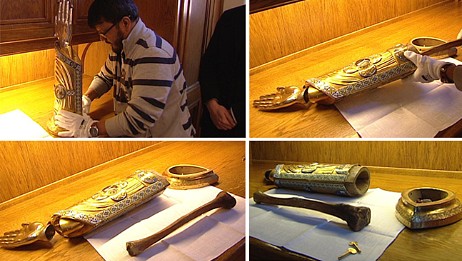
Relikvien i St Olav domkirke i Oslo er virkelig hl Olavs leggben

13mars_olavsrelikvien
NRK meldte i går ettermiddag:

Religionshistoriker Øystein Morten ville knuse noen myter og bygge noen sannheter om vikingkongen Olav Haraldsson, bedre kjent som Olav den Hellige.

Jakten startet ved en monter i Sankt Olav domkirke i Oslo, der en relikvie har stått i mange år. Den utsmykkede beholderen inneholder et ben, som trolig stammer fra Olav.

«Jeg trodde det var en liten flis, så jeg ble forundret da jeg så det. Det er et 40 centimeter langt, ganske kraftig ben, som rett og slett ikke har blitt undersøkt», sier Morten.

Den katolske kirken gikk med på å frigi benet til undersøkelser, og den første var en karbondatering for å finne ut når eieren døde.

«Det ble så nære klaff som vi kan komme. Vi kan si sikkert at han døde i slutten av 900-tallet eller opp mot 1040. Men mest sannsynlig rundt 1030. Undersøkelsene viste at personen var mellom 25 og 35 da han døde. Olav var trolig 35 eller litt yngre da han døde på Stiklestad», sier Morten. …

NRKs innlegg innholder også en del mer informasjon – og en video.

Pave Frans støttet valget av pave Benedikt i 2005

Det skriver Sandro Magister på www.chiesa:

By electing as pope at the fourth scrutiny the archbishop of Buenos Aires Jorge Mario Bergoglio, the conclave has made a move as surprising as it is brilliant.

Surprising for those – almost everyone – who had not noticed, during the preceding days, the effective appearance of his name in the conversations among the cardinals. His relatively advanced age, 76 years and three months, led him to be classified more among the great electors than among the possible elect.

In the conclave of 2005 the opposite had happened for him. Bergoglio was one of the most decisive supporters of the appointment of Joseph Ratzinger as pope. And instead he found himself voted for, against his own will, precisely by those who wanted to block the appointment of Benedict XVI.

The fact remains that both one and the other became pope. Bergoglio with the unprecedented name of Francis. …..

Les hele denne artikkelen her.

Hvilken Frans har den nye paven tatt sitt navn fra?

Alle ser ut til å tenke at det er hl Frans av Assisi som er helgenen bak det nye pavenavnet, men kunne det ikke være like naturlig (for en jesuitt) at det er den hellige Frans Xaver – verdens nest mest kjente jesuitt (etter hl Ignatius) og Kirkens nest mest kjente misjonær (etter apostelen Paulus)? Det kan også være en annen kjent jesuitt, hl Frans Borgia, en av de første jesuittgeneralene.

Selv kjenner jeg godt til hl Frans Xaver pga Fransiskus-søstrene i Bergen, der jeg bodde i mange år. Han var med og stiftet Jesuitt-selskapet, og var deretter misjonær i India, Sri Lanka og Japan, og døde på vei inn (for å misjonere) i Kina.

Vi blir sikkert informert om dette etter hvert – og det kan jo være at flere av disse helgenene sammen han fått paven til å velge navnet Frans.

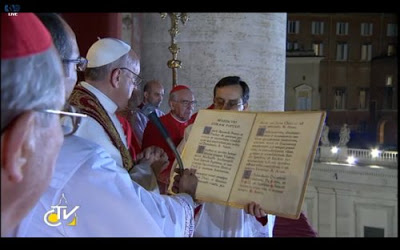
Pave Frans I

francis_1

Annuntio vobis gaudium magnum. Habemus Papam.

Eminentissimum ac Reverendissimum Dominum. Dominum Georgium Marium
Sanctae Romanae Ecclesiae Cardinalem Bergoglio.

Qui nomen sibi imposuit Franciscum.

Imponerende at katolsk.no hadde klar en presentasjon av den nye paven – på tross av at valget var nokså overraskende.

Slik skal den nye paven kunngjøres

På katolsk.no kan vi lese en interessant og morsom side som forteller hvordan den nye pavens navn kunngjøres av protodiakonen. Først sier han «Annuntio vobis gaudium magnum; Habemus Papam!” Deretter sier han den nye pavens døpe-/fornavn, og her har man laget en liste over de mest aktuelle kandidatene, slik at man kan gjenkjenne personen før etternavnet (etter flere kunstpauser) endelig nevnes. Her er listen:

Petrum – f.eks. Peter Turkson og Peter Erdö
Angelum – f.eks. Angelo Scola og Angelo Bagnasco
Marcum – f.eks. Marc Ouellet
Ioannem Francus — f.eks. Gianfranco Ravasi
Leonardum – f.eks. Leonardo Sandri
Christophorum – f.eks. Christoph Schönborn
Timotheum – f.eks. Timothy Dolan
Ioannem – f.eks. Sean O’Malley
Ludovicem – f.eks. Luis Antonio Gokim Tagle

Under ser vi hvordan dette gjøres i oktober 1978, da pave Johannes Paul II ble valgt – en interessant video jeg aldri hadde sett før.

Svart røyk kl 19.41

Fra bloggen «Whispers in the Loggia»:

The First Scrutiny having been completed, at 7.41pm Rome, the Black Smoke billowed out of the Sistine Chimney.

As previously mentioned, the opening ballot’s principal purpose is to provide the first complete picture of who the electors view as contenders (and don’t), allowing early bases of significant support to be built upon, and less prevalent ones to be winnowed into other blocs.

In other words, only on the basis of tonight’s snapshot does the papal «horse-race» – which the Italians have dubbed «Il Totopapa,» the «Popestakes» – begin in earnest. With the cardinals now locked away and cut off from the world outside for the duration, though, only after the 266th Pontiff emerges will we learn how that shaped out.

The day’s official business ended, the cardinals are being transported back to the «Conclave Hotel» at the Domus for dinner in common and discussions likely to extend into the night.

The usual voting pattern begins tomorrow as Ballots 2 and 3 get underway at 9.30am Rome. Expected to be another round of black, the smoke signaling the combined end of both votes can be expected sometime around Vatican Noon. Barring a resolution, Ballots 4 and 5 would then start at 4.30pm, with their smoke to come in the area of 6pm or later. (Repeat cycle until white smoke or, should it be necessary, the mandatory pause-day for reflection would kick in, apparently on Saturday.) …..

Konklavet begynner tirsdag 12. mars

PRESS COMMUNIQUÉ FROM THE HOLY SEE PRESS OFFICE

The eighth General Congregation of the College of Cardinals has decided that the Conclave for the election of the Pope will begin on Tuesday, 12 March 2013.

A «pro eligendo Romano Pontifice» Mass will be celebrated in St. Peter’s Basilica in the morning. In the afternoon the cardinals will enter into the Conclave.

Fra Vatikanets egne nettsider.

Det sixtinske kapell gjøres klar

Her kan man lese en lang artikkel om Det sixtinske kapell.

På katolsk.no kan man bl.a. lese følgende om forberedelsen til konklavet (jeg syns det er underlig at man kan skrive at man ser konturene av «den fremtidige pavens profil», tenker kardinalene så praktisk og taktisk når de velger ny pave?):

153 kardinaler deltok under dagens møte. Fire nye kardinalelektorer er ankommet Roma. Dette betyr at 113 av i alt 115 stemmeberettigede nå er til stede. … 18 kardinaler holdt innlegg i dag. Pågangen er stor, og taletiden er satt ned til fem minutter per innlegg. Kardinalene har bestemt å ha to daglige møter de neste dagene, formiddag og ettermiddag.

… I lys av dagens diskusjoner om blant annet nyevangelisering, pastorale utfordringer og forholdet mellom kurien og lokale bispedømmer, ser vi nå konturene av «den fremtidige pavens profil», ifølge fr. Federico Lombardi.

… De amerikanske kardinalene har avlyst sin daglige pressekonferanse etter at kardinalkollegiet skal ha uttrykt bekymring for anonyme lekkasjer til italienske medier fra de konfidensielle møtene.

Vårt Land: Skrot sølibatskravet

Vårt Land skrev følgende på lederplass torsdag sist uke:

SELV OM norske katolikker er en liten gruppering internasjonalt, er veksten så stor at pave Benedikt XVI har omtalt Norge som et land med katolsk vekst.

BERNT EIDSVIG, som er biskop i den katolske kirken. i Norge, sa til Dagen i går ar han dusker at den nye paven bor se på pliktsølibatet på nytt, «Det er viktig å ta diskusjonen med en viss åpenhet. Jeg vil ikke spekulere i hva konklusjonen blir, men paven bor ta diskusjonen», sier Einsvig,

TILHENGERE AV sølibatkravet argumenterer med at hvis sjelens frelse er kirkens viktigste mål, blir tilgjengelighet viktig, Prestens tilgjengelighet som sjelesørger og omsorgsperson blir et argument for sølibatet. En prest uten familie kan vie seg til sitt kall og legge fra seg alt, for utelukkende å gi seg hen til den ene oppgaven redde sjeler over til det evige liv.

VI MENER at Eidsvigs innspill er viktig og betimelig. Ser man på den bakenforliggende årsaken til at den katolske kirke krever at deres prester lever i sølibat, er det nemlig ikke en teologisk, men en historisk begrunnelse som ligger bak. ….

Det er nå likevel svært liten grunn til å tro at Den katolske Kirke (den latinske ritus) vil få gifte prester – bortsett fra unntaklstilfeller, som bl.a. meg selv. I 2009 – i forbindelse med starten av det anglikanske ordinariatet – ble det bl.a. skrevet følgende:

… … Indeed, it seems that every time the celibacy issue is pushed, there’s a swift pullback to defend the current rule.

The day before details of the Anglican plan were made public, Pope Benedict XVI went out of his way to underline the importance of priestly celibacy during a visit to the northern Italian city of Brescia. Citing Pope Paul VI, he said celibacy was the way a priest «configures himself most perfectly to Christ,» manifesting and reflecting Christ’s own love for his church.

A few days earlier, the Vatican newspaper ran a long article by Italian Cardinal Dionigi Tettamanzi of Milan, who defended priestly celibacy as a choice that can attract and inspire people, without «impoverishing and even less suffocating the values of sexuality.»

Cardinal Tettamanzi’s predecessor, Cardinal Carlo Maria Martini, is among those who have suggested the church find ways to «adapt» its celibacy rule in different situations. Some have said that, specifically where the priest shortage is greatest, exceptions might be made to ordain married men of «proven virtue.»

The issue has been raised in several synods of bishops, including one on priestly formation in 1990, where the reaction was typical: after a minority of bishops asked that qualified married men be ordained, the synod as a whole ended by voicing strong support for mandatory celibacy. Pope John Paul II quickly accepted the synod’s action and branded calls for ordaining married men as «systematic propaganda hostile to priestly celibacy.»

In 1993, a few weeks after bishops in western and northern Canada asked the Vatican to consider allowing married priests in sparsely populated areas, Pope John Paul told Canadian bishops that dropping the celibacy rule was «not the path to follow» in addressing a shortage of priests.

A similar pattern of events occurred during the 2005 synod on the Eucharist. Several Latin-rite bishops, citing the scarcity of priests in their regions, suggested ordaining married men. But the synod’s final propositions rejected that idea, and Pope Benedict closed the synod by praising celibacy as a «precious gift» for the whole church. …

Seminar arrangert av Nettverk for katolsk teologi

I går deltok jeg på det årlige seminaret arrangert av Nettverk for katolsk teologi, som i år tok opp liturgiske temaer. Første foredrag var ved P. Ole Martin Stamnestrø, og det handlet om: «Det annet Vatikankonsils lære om liturgien med særlig vekt på begrepet actuosa participatio.»

Universitetslektor Sigurd Hareide snakket deretter om: «Fra aktiv til passiv deltakelse? Om reformasjonens liturgireform.»

Under og etter disse to foredragene ble det uttrykt ganske stor enighet om at liturgien i vår tid er i en fase der ting fornyes, ut fra Kirkens gamle tradisjon. Den liturgiske forfalls- eller forråtnelsesforståelsen (at liturgien etter ca 500, utover middelalderen, forfalt mer og mer) er nå stort sett forlatt av alle, ble det sagt.

I mitt eneste innlegg i samtalen sa jeg likevel at selv om forfallsteorien er forlatt av ekspertene, har dette ikke kommet helt ned til grasrota mange steder. At det nok vil ta litt tid før vi ser noen særlig forandring av liturgiforståelsen og messefeiringen blant prester flest, og at man knapt kan lære av Kirkens liturgiske tradisjon hvis man ikke kjenner denne – og det er i dag få prester som har noe som helst kjennskap til liturgien før 1970.

P. Haavar Simon Nilsen: «Vennskap og handling – nye perspektiver på liturgien.»

Dette siste foredraget bygget på tanker av filosofen John Macmurray. Dette stoffet var helt nytt for meg, men p Haavar har skrevet om det på sin blogg, der hans mastergradsoppgave fra Oxford (om dette temaet) nå kan lastes ned.

Derfor var pave Benedikt viktig for meg

Den amerikanske – delvis engelske, tidligere anglikanske og (fortsatt) gifte – presten Fr. Longenecker skriver på sin blogg i 10 punkter om hvorfor pave Benedikt har vært så viktig for ham. Her er det tre første:

1. He granted the dispensation from the vow of celibacy that opened the door for my ordination as a Catholic priest.

2. He established the Anglican Ordinariate. While I am not a priest in the Ordinariate, I have great interest in the ordinariate and its progress. I believe history will show Benedict XVI to have been a revolutionary pope when it comes to ecumenism–showing new ways for Christians to come into full communion with the Holy See.

3. He showed the way of truly Christian Biblical scholarship. He did not reject the findings of modern Biblical critics as fundamentalists do, nor did he adopt modernism and promote it. Instead was truly Catholic in his approach. He gleaned from all Biblical scholars what was true and good, and he also rejected that which was inconsistent, heretical, merely theoretical and unsubstantiated. His Biblical scholarship was thorough and erudite, yet fully within the magisterium of the church. …

Også i mitt tilfelle var pave Benedikt viktig da det ble søkt om dispensasjons fra sølibatskravet for meg. Selv om det var pave Johannes Paul II som formelt sett ga tillatelsen, var det Troskongregasjonen som gjorde alt arbeidet, dvs. forberedte saken. Og da mine papirer i ca 8 mnd hadde ligget nederst i bunker av papir, var det biskop Schwenzers brev direkte til kardinal Ratzinger som sørget for at prosessen kom i gang, og dispensasjonen endelig ble sendt til Oslo i juni 1999.

Skroll til toppen