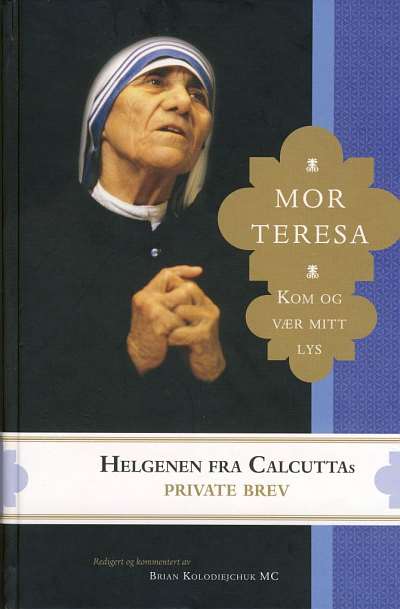
 Denne boka, som i Norge gis ut av Luther forlag i disse dager, heter opprinnelig «Come Be My Light», og kom ut i 2007, 10 år etter at Mor Teresa døde. Denne bemerkelsesverdige og verdensberømte nonnen mottok et «kall i kallet» til å tjene de fattigste av de fattige i Calcuttas slum. I denne oppsiktsvekkende biografien kan vi lese Mor Teresas private brev til sine åndelige veiledere, samlet i forbindelse med hennes helligkåringsprosess. Brevene avslører hittil ukjente dybder ved hennes åndelige liv og den paradoksale og uventede prisen hun måtte betale for sitt kall – at hun selv skulle leve i «fryktelig mørke». Dette var sider som var skjult for selv hennes aller nærmeste medarbeidere.
«Mørket er slik at jeg virkelig ikke kan se – verken med min sjel eller med fornuften – Guds rom i min sjel er tomt – det er ingen Gud i meg – Noen ganger hører jeg kun mitt eget hjerte rope `Min Gud’ og intet annet – jeg kan ikke forklare torturen og smerten -»
Dette meldte katolsk.no i går – og selv skrev jeg om dette ‘mørket’ i august 2007:
I forbindelse med (litt før) at Teresa av Calcutta ble saligkåret i 2003, kom det fram opplysninger om hennes åndelige mørke. Så når vi de siste par ukene har hørt mer om dette temaet, får vi bare mer oppøysninger om det vi allerede visste. Men ikke alle har visst det, og bl.a. Dagbladet hadde et noe sensasjonelt oppslag om det for noe få dager siden – spesielt overskrifta: Mor Teresa mistet Gud. Men Dagbladet har nå i sitt magasin skrevet en mye bedre artikkel om saken, der de bl.a. skriver:
“I dette ligger Teresas storhet: På tross av at hun ikke hadde en følelig trøst i forbindelse med sitt gudsforhold, levde hun som Gud ønsket det av henne. Hun satte seg selv til side.”
Også i f.eks. Time Magazine ble det skrevet om denne boka, da den kom ut på engelsk i august i fjor:
On Dec. 11, 1979, Mother Teresa, the «Saint of the Gutters,» went to Oslo. Dressed in her signature blue-bordered sari and shod in sandals despite below-zero temperatures, the former Agnes Bojaxhiu received that ultimate worldly accolade, the Nobel Peace Prize. In her acceptance lecture, Teresa, whose Missionaries of Charity had grown from a one-woman folly in Calcutta in 1948 into a global beacon of self-abnegating care, delivered the kind of message the world had come to expect from her. «It is not enough for us to say, ‘I love God, but I do not love my neighbor,'» she said, since in dying on the Cross, God had «[made] himself the hungry one — the naked one — the homeless one.» Jesus’ hunger, she said, is what «you and I must find» and alleviate. She condemned abortion and bemoaned youthful drug addiction in the West. Finally, she suggested that the upcoming Christmas holiday should remind the world «that radiating joy is real» because Christ is everywhere — «Christ in our hearts, Christ in the poor we meet, Christ in the smile we give and in the smile that we receive.»
Yet less than three months earlier, in a letter to a spiritual confidant, the Rev. Michael van der Peet, that is only now being made public, she wrote with weary familiarity of a different Christ, an absent one. «Jesus has a very special love for you,» she assured Van der Peet. «[But] as for me, the silence and the emptiness is so great, that I look and do not see, — Listen and do not hear — the tongue moves [in prayer] but does not speak … I want you to pray for me — that I let Him have [a] free hand.»