Katolsk

Katolsk tidsskrift kritiserer katolsk biskop

The Confraternity of Catholic Clergy i England arrangerer en interessant konferanse i oktober. Her skal bl.a. en engelsk, katolsk biskop delta, noe som får en skribent i det katolske tidssktiftet the Tablet til «å se rødt» (fra continuity-bloggen):

… the Tablet observes that Bishop Egan’s appointment was seen as «part of a trend to appoint outspoken defenders of Church teaching to dioceses in England and Wales.» How dreadful! Fancy appointing Bishops who are outspoken defenders of the teaching of the Church! Most of us might see the defence of the teaching of the Church as an uncontroversial requirement of Canon Law for the appointment of Bishops. In Tablet-speak it makes him a «rising star for the conservative wing of the Church in England and Wales.» Can they really mean that the other Bishops are generally not outspoken defenders of the teaching of the Church? Perish the thought!

In classic Tablet style, the Notebook piece was used as a dolly-up for a thunderous letter the following week … Mr Angry refers to Bishop Egan’s nefarious role as Church teaching defender, along with his guilt by association with Bishop Mark Davies. He reckons that «The plans and purposes of this confraternity should be made known as widely as possible, openly debated and wherever necessary vigorously opposed.»

Her er så noe av det aktuelle leserinnlegget i the Tablet:

… The plans and purposes of this confraternity should be made known as widely as possbile, openly debated and wherever necessary vigorously opposed. Being in his diocese, I am able to get a very good idea of the mentality of the confraternity from Bishop Davies’ own Shrewsbury Voice. It is reaction itself. It stands for a return of the Church to how it was before the Second Vatican Council. It holds to an excessive, hence highly unbalanced, interpretation of the role and power of the papacy which has no foundation in biblical and patristic sources. This is the pool from which episcopal appointments are now, and will be, made. It is totally unable to distinguish between its version of ecclesiology, the sacraments, male and female relationships, and so on from what is also now on offer, and has been for many centuries, in the Universal Church. The confraternity is a gathering of the like minded who root themselves in the nineteenth century and pre-Second World War Europe. It has influence, and its influence will grow. It has to be challenged, by whatever way it does it, by the rest of the hierarchy itself; by the clergy and with the equal involvement of the Catholic laity which is now anything but the subservient layer of the Church which the confraternity would like to return it to. …

Pave Benedikt om Guds lov

Litt forsinket kommer her pave Benedikts preken til Angelus-bønnen sist søndag:

Dear Brothers and Sisters,

The theme of God’s Law, of his commandments, makes its entrance in the Liturgy of the Word this Sunday. It is an essential element of the Jewish and Christian religions, where the complete fulfilment of the law is love (cf. Rom 13:10). God’s Law is his word which guides men and women on the journey through life, brings them out of the slavery of selfishness and leads them into the “land” of true freedom and life. This is why the Law is not perceived as a burden or an oppressive restriction in the Bible. Rather, it is seen as the Lord’s most precious gift, the testimony of his fatherly love, of his desire to be close to his People, to be its Ally and with it write a love story.

This is what the devout Israelite prays: “I will delight in your statutes, / I will not forget your word…. Lead me in the path of your commandments, / for I delight in it” (Ps 119[118]:16, 35). In the Old Testament the person who passes on the Law to the People on God’s behalf is Moses. After the long journey in the wilderness, on the threshold of the promised land, he proclaims: “Now, O Israel, give heed to the statutes and the ordinances which I teach you, and do them; that you may live, and go in and take possession of the land which the Lord, the God of your fathers, gives you” (Deut 4:1). And this is the problem: when the People put down roots in the land and are the depository of the Law, they are tempted to place their security and joy in something that is no longer the Word of God: in possessions, in power, in other ‘gods’ that in reality are useless, they are idols. Of course, the Law of God remains but it is no longer the most important thing, the rule of life; rather, it becomes a camouflage, a cover-up, while life follows other paths, other rules, interests that are often forms of egoism, both individual and collective.

Thus religion loses its authentic meaning, which is to live listening to God in order to do his will — that is the truth of our being — and thus we live well, in true freedom, and it is reduced to practising secondary customs which instead satisfy the human need to feel in God’s place. This is a serious threat to every religion which Jesus encountered in his time and which, unfortunately, is also to be found in Christianity. Jesus’ words against the scribes and Pharisees in today’s Gospel should therefore be food for thought for us as well.

Jesus makes his own the very words of the Prophet Isaiah: “This People honours me with their lips, but their heart is far from me; in vain do they worship me, teaching as doctrines the precepts of men” (Mk 7:6-7; cf. Is 29,13). And he then concludes: “You leave the commandment of God, and hold fast the tradition of men” (Mk 7:8).

The Apostle James too alerts us in his Letter to the danger of false piety. He writes to the Christians: “Be doers of the word, and not hearers only, deceiving yourselves” (Jas 1:22). May the Virgin Mary, to whom we now turn in prayer, help us to listen with an open and sincere heart to the word of God so that every day it may guide our thoughts, our decisions and our actions.

Kardinal Carlo Maria Martinis «åndelige testamente»

Flere steder har vi lest om det siste intervjuet med Milanos tidligere erkebiskop, Kardinal Carlo Maria Martini, noen uker før han døde 31/8. Jeg vil gjøre det klart at jeg ikke deler hans synspunkter, faktisk syns jeg de er ganske sjokkerende. Men her er intervjuet i John Allens oversettelse, med følgende innledning:

Cardinal Carlo Maria Martini died in Varese, northern Italy, on Aug. 31 at the age of 85. Two weeks earlier, on Aug. 8, Martini gave a final interview to his fellow Jesuit Fr. George Sporschill, with whom Martini had collaborated on a book titled Nocturnal Conversations in Jerusalem, and an Italian friend named Federica Radice Fossati Confalonieri. Radice has told Italian media outlets that Martini read and approved the text of the interview, intending it as a sort of «spiritual testament» to be published after his death.

Og her litt av intervjuet:

What tools do you recommend against the exhaustion of the church?

I recommend three very strong ones. The first is conversion: the church must recognize its errors and follow a radical path of change, beginning with the pope and the bishops. The pedophilia scandals compel us to take up a path of conversion. Questions about sexuality, and all the themes involving the body, are an example. These are important to everyone, sometimes perhaps too important. We have to ask ourselves if people still listen to the advice of the church on sexual matters. Is the church still an authoritative reference in this field, or simply a caricature in the media?

The second is the Word of God. Vatican II gave the Bible back to Catholics. Only those who perceive this Word in their heart can be part of those who will help achieve renewal of the church, and who will know how to respond to personal questions with the right choice. The Word of God is simple, and seeks out as its companion a heart that listens. … Neither the clergy nor ecclesiastical law can substitute for the inner life of the human person. All the external rules, the laws, the dogmas, are there to clarify this internal voice and for the discernment of spirits.

Who are the sacraments for? These are the third tool of healing. The sacraments are not an instrument of discipline, but a help for people in their journey and in the weaknesses of their life. Are we carrying the sacraments to the people who need new strength? I think of all the divorced and remarried couples, to extended families. They need special protection. The church upholds the indissolubility of matrimony. It’s a grace when a marriage and a family succeed …

The attitude we hold towards extended families determines the ability of the church to be close to their children. A woman, for instance, is abandoned by her husband and finds a new companion, who takes care of her and her three children. This second love succeeds. If this family is discriminated against, not only is the mother cut out [from the church] but also her children. If the parents feel like they’re outside the church, and don’t feel its support, the church will lose the future generation.

Before communion, we pray: «Lord, I am not worthy …’ We know we’re not worthy … Love is a grace. Love is a gift. The question of whether the divorced can receive communion ought to be turned around. How can the church reach people who have complicated family situations, bringing them help with the power of the sacraments? …

Fra en av de berømte liturgiukene i USA

En blogg jeg nettopp kom over – conciliaria.com – skriver om det som skjedde ved oppstarten av konsilet for 50 år siden. Nylig skrev de – dvs. presenterte gamle dokumenter som skrev – om den liturgiske konferansen som ble holdt i Seattle i juni 1962. En konferanse som ble beskrevet slik:

What is a Liturgical Week?
The first Liturgical Week, sponsored by the National Liturgical Conference, was held in 1940, in a room in the basement of Holy Name Cathedral in Chicago. It was attended by just a handful of people, mainly priests. But these days, it is clear that the Liturgical Movement is not just a fad or a trend, nor is it only for priests. Pope Pius XII, and his successor, our beloved Pope John XXIII, have embraced the Liturgical Movement as the work of the Church itself. Last year’s Liturgical Week in Oklahoma City drew about 5,000 people–priests, religious, and laity–who came together to pray together and to learn more about the Church’s worship and to explore displays, listen to lectures, view demonstrations and art exhibits, and even take part in a contest for the best church design. This year’s Liturgical Week in Seattle is expected to be the largest yet, with as many as 6,000 participants. The added attraction of the World’s Fair, and the excitement about the forthcoming Ecumenical Council, both have something to do with the surge of interest in the Liturgical Week. LES MER HER.

Bloggen viser også til en annen artikkel som ble skrevet om lturgien, etter at konferansen var over, og som tok med et bilde (over) av den første messen som ble feiret versus populum i Seattle:

From the June 28, 1962 issue of Commonweal Magazine, a provocative call for liturgical reform by an organizer of the North American Liturgical Week recently held in Seattle in conjunction with the World’s Fair, imagining how liturgy might be celebrated 50 years from now. LES MER HER.

28. august: Den hellige Augustin

I dag feirer Kirken den hellige biskop og kirkelærer, Augustin. Om ham leste vi i dag i de tradisjonelle tidebønnene:

Augustine was born of good parents at Tagaste in Africa, and in a short time surpassed all his companions in learning. As a young man, when in Carthage, he fell into the Manichean heresy. Later he went to Rome and was sent from there to Milan to teach rhetoric. At Milan, he was persuaded by Monica, his most devout mother, to become a frequent listener to the Bishop Ambrose. Ambrose brought it about that Augustine was fired with a desire for the Catholic faith, and baptized him when he was thirty-three years old. Going back to Africa, Augustine led a life governed by religion and holiness, and was made priest by Valerius, Bishop of Hippo, renowned for his sanctity. At this same period, he founded a religious community with whom he lived, taking part in their life and worship while he trained them very carefully to the apostolic life and to learning. Moved by his devotion, Valerius made him his coadjutor bishop. He wrote many works remarkable for their devotion, subtlety and diffuseness, to combat heresies and throw light on Christian teaching. When the Vandals were laying Africa waste and Hippo had been besieged for three months, he was taken with a fever and went to the Lord in the seventy-sixth year of his age. His body was buried first in Sardinia and then in Pavia, where it is venerated with honour.

Et bordalter er tatt bort

Det er nok en stund til slike ting begynner å skje i Norge, men i andre land begynner det nå langsomt; at bordalter som ble plassert i kirkenes kor på 70-tallet, nå tas bort. Dette eksempelet er fra the Assumtion Grotto i Detroit, der sognepresten skriver bl.a.:
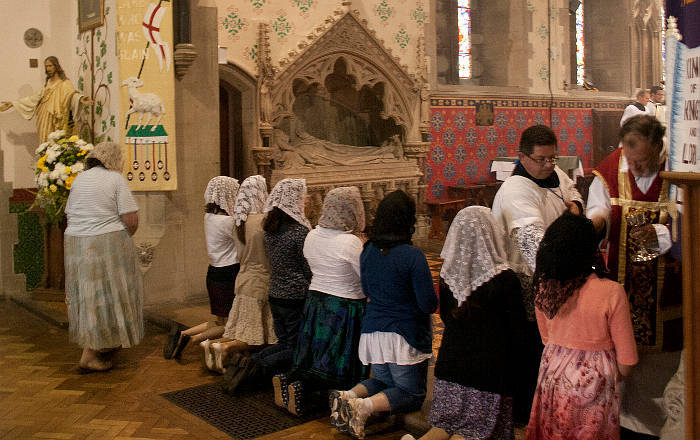
… many of you, though not all, noticed a change in the sanctuary of the church last weekend. The low altar had been removed, allowing the high altar to shine in its full original splendor. Although I had intended to write to you about this in advance of its ouster, events moved too swiftly for me to do that. Our Parish Council members had been foretold of this intention sometime ago. No one then showed any dissatisfaction with the proposal. Indeed, everyone seemed intrigued to know how the church would have looked at its construction. I offer a brief ‘unscientific’ history of this subject.

… After the Second Vatican Council there was a popular movement in liturgical circles to have the Mass celebrated with the priest facing the people, even though this was never mandated by the Council nor by any subsequent directive of the Holy See. Grotto Church, like most others, began the practice with a temporary altar set up in the great open space before the high altar (which space had been created for the old solemn ceremonies of the Latin liturgy) so that a priest could celebrate Mass towards the people. … In 1978 Monsignor Sawher decided to replace the temporary low altar with a dignified and indeed beautiful marble altar that would in many ways be harmonious with the existing decor.

When I carefully studied the book The Spirit of the Liturgy by then-Cardinal Ratzinger (now Pope Benedict XVI), I realized that we ought to be facing East once again and not towards the people since that position inadvertently created a “closed circle” that did not aim towards heaven, towards God (East), but towards man (symbolically indicating that man and not God was the focal point of the Mass). In the early years of my pastorship here, the low altar was used variously: first, facing the people; then facing East; and then, with a move of the altar farther back some feet towards the main altar, with the priest still facing East. We were getting progressively more in line with an ideal.

… Fine, you may say, but what is to be done should a visiting priest want to celebrate Mass facing the people? We have already provided for that in having readily available an altar that can be set in place in a matter of minutes. It too is suitably made, containing an true altar stone and thus worthy of Holy Mass.

Hyrdebrev om ekteskapet i Skottland

I går, søndag, ble et hyrdebrev om ekteskapet lest opp i alle katolske kirker i Skottland, siden det der i det siste har vært mye diskusjon om innføringen av en kjønnsnøytral ekteskapslov. Og biskopene skrev bl.a. (les mer her):

… We write to you having already expressed our deep disappointment that the Scottish Government has decided to redefine marriage and legislate for same-sex marriage. We take this opportunity to thank you for your past support in defense of marriage and hope you will continue to act against efforts to redefine it. We reaffirm before you all the common wisdom of humanity and the revealed faith of the Church that marriage is a unique life-long union of a man and a woman. In circumstances when the true nature of marriage is being obscured, we wish to affirm and celebrate the truth and beauty of the Sacrament of Matrimony and family life as Jesus revealed it; to do something new to support marriage and family life in the Catholic community and in the country; and to reinforce the vocation of marriage and the pastoral care of families which takes in the everyday life of the Church in dioceses and parishes across the country. For that reason, in the forthcoming Year of Faith we have decided to establish a new Commission for Marriage and the Family. … The new Commission will promote the true nature of marriage as both a human institution and a union blessed by Jesus. The Commission will be asked to develop an online presence so that prayer, reflection, formation and practical information on matters to do with marriage and family life can be quickly accessible to all. It will also work to produce materials and organise events which will support ordinary Catholic families in their daily lives. During the course of the coming year we will ask for your support for these initiatives. Our faith teaches us that marriage is a great and holy mystery. The Bishops of Scotland will continue to promote and uphold the universally accepted definition of marriage as the union solely of a man and a woman. At the same time, we wish to work positively for the strengthening of marriage within the Church and within our society. This is an important initiative for all our people, but especially our young people and children. We urge you to join us in this endeavour. Pray for your own family every day, and pray for those families whose lives are made difficult by the problems and cares which they encounter. Finally, we invite you to pray for our elected leaders, invoking the Holy Spirit on them, that they may be moved to safeguard marriage as it has always been understood, for the good of Scotland and of our society.

Bør den eukaristiske fasten igjen bli tre timer?

Hos Rorate Cæli fikk jeg tips om et nytt dokument om liturgien fra engelske Latin Mass Society. Dette siste dokumentet i denne serien argumenterer for at en tre timers faste før mottagelsen av kommunion bør gjeninnføres – og jeg syns nok argumentene har noe for seg. (Inntil 1953/-57 var det i over 1000 år obligatorisk faste fra midnatt før kommunion, så ble dette redusert til tre timer, og på 60-tallet til bare én time – noe som i prasis er nesten ingen ting.)

I dokumentet leser vi bl.a.:

On this topic, and on the topic of Holy Days of Obligation, which we will be dealing with in the future, Catholics attending the Traditional Mass are governed by Canon Law, and the provisions of their local bishops, which have changed the legal structure the liturgy works within. The Canon legal situation in 1962 was that we were obliged to fast for three hours before receiving Communion (see Appendix B for the full details); a few years earlier, we had been obliged to fast from Midnight. The seriousness the midnight fast, and even the three hour fast, implied about the reception of Holy Communion, accorded with the seriousness implied by the ancient liturgy itself. These fasts were something which Catholics intending to receive Holy Communion had to think about; every now and then people would not receive Communion because it was not practical to observe the fast, that is, to give the Blessed Sacrament the honour which is its due. (Although, in fact, the exceptions to the three-hour fast after 1957 were extremely generous: see Appendix C.)

By contrast – and I think I can say this without offending anyone – the one-hour fast is not serious. The motivation for it is obvious enough, to make things easier for the Faithful, but it no longer tells us that the reception of Holy Communion is something to be prepared for with care, and undertaken with fear and trembling. It does not accord with the seriousness implied by the ancient Mass.

Since the decision has been taken by the Holy Father to treat the Traditional Latin Mass, from a legal point of view, as a ‘form’ of the same Rite as the Novus Ordo, rather than as a separate Rite, it does not make sense to argue for a different, binding discipline for the Eucharistic Fast for Catholics attending the TLM, than for Catholics attending the Novus Ordo. Within this context, we must argue for a revision of the discipline for all Catholics of the Latin Rite. And it seems to us that this is an opportune moment to do just that.

Les hele dokumentet her.

Pius X feires i dag (eller 3. september)


Jeg feiret nettopp messen i St Hallvard kirke, og mintes den hellige pave Pius X, siden der er 21. august. Jeg har fridag tirsdag og feirer da vanligvis en privatmesse i den tradisjonelle form, men i dag var dte ingen andre prester her, så jeg måtte feire menighetsmessen.

Og om Pius X og hans minnedag skriver katolsk.no:

… Tidlig på morgenen den 20. august 1914 døde Pius X i Roma av en lungebetennelse. Etter hans eget ønske ble han bisatt i en prunkløs sarkofag i grotten i Peterskirken. Han skrev i sitt testamente: «Jeg ble født fattig, har levd som fattig og jeg ønsker å dø fattig.»

Pius X var på mange måter dypt konservativ, og ble også ansett slik av samtidige. Men han hører også til de største og mest konstruktive reformpavene på grunn av reorganiseringen av kurien og nyordningen av kirkeretten, men særlig på grunn av den religiøse fornyelsen av Kirken han sterkt hadde fremmet. Målet for Pius Xs pontifikat, å «fornye alle ting i Kristus», kunne han langt på vei virkeliggjøre. Han karakteriseres som en «konservativ reformpave», og vil alltid ha en fremtredende plass i pavehistorien.

Pius X ble tillagt mirakler ennå mens han levde, og italienerne kalte ham allerede da «il Papa Santo». Straks etter hans død var det et inntrengende folkelig ønske om hans kanonisering. Prosessen begynte i 1923, og han ble saligkåret av Pius XII den 3. juni 1951, og den 29. mai 1954 ble han helligkåret som den første pave på 242 år. Hans minnedag var opprinnelig den 3. september, men siden 1969 er den 21. august.

Jeg vet ikke hvorfor man først (da han ble helligkåret i 1954) valgte 3. september som minnedag, men nå feires han så nær sin dødsdag som praktisk mulig. Wikipedia skriver:

Pius X’s feast day was assigned in 1955 to 3 September, to be celebrated as a Double. It remained thus for 15 years. In the 1960 calendar (incorporated in the 1962 Roman Missal of Pope John XXIII, whose continued use as an extraordinary form of the Roman Rite is authorized under the conditions indicated in the motu proprio Summorum Pontificum) the rank was changed to Third-Class Feast. The rank in the General Roman Calendar since 1969 is that of Memorial and the feast day is obligatorily celebrated on 21 August, closer to the day of his death (20 August, impeded by the feast day of St Bernard).

I orden for de Transalpine Redemptoristene


Catholic Herald melder at den fire år lange ventetiden nå er over for disse prestene:

The Congregation of the Sons of the Most Holy Redeemer, also known as the Transalpine Redemptorists, was erected today, on the feast of the Assumption, as a Clerical Institute of Diocesan Right. The community, which has about 15 members, has been in limbo since 2008 when it announced that it wished to enter into full communion with Rome.

The group’s decision was a response to Pope Benedict XVI’s Motu Proprio Summorum Pontificum, which allowed priests to celebrate the traditional Latin Mass freely.

Previously, the community had been a part of the worldwide Society of St Pius X (SSPX), the estranged traditionalist group currently in dialogue with Rome.

Next Wednesday evening, August 22, the community are to make a public profession of vows at their home on Papa Stronsay, a tiny, windswept island in Orkney, off the north-east of Scotland. The profession will be celebrated by Bishop Hugh Gilbert OSB of Aberdeen, who, as their diocesan bishop, granted them canonical recognition.

Bishop Gilbert was ordained as Bishop of Aberdeen exactly a year ago, taking over from Bishop Peter Moran, who had retired.

Brødrene skriver også om dette på sin egen blogg.

«Maria hører våre bønner i himmelen», sier pave Benedikt

På the Catholic Herald leser vi om pavens messe på denne store høytidsdagen for jomfru Maria:

Assumed into heaven, Mary is with God and is ready to listen and respond to cries for help, Pope Benedict XVI has said. Joining God in heaven, Mary “does not draw away from us, does not go to an unknown galaxy”, but becomes “even closer to each one of us”, the Pope said during his homily today at Mass for the feast of the Assumption.

… The Pope celebrated an early morning Mass in the Church of St Thomas. … Mary’s assumption, he said, gives believers “a sure hope: God expects us, he awaits us. We are not moving toward a void.” “And going to that other world, we will find the goodness of the Mother [Mary], we will find our loved ones, we will find eternal love,” the Pope said.

Pope Benedict, who set aside his prepared text for much of his homily, said that Mary’s closeness to God ensures her closeness to all God’s creatures. “Mary, totally united with God, has a heart that is so big that all creation can find a place there,” a fact illustrated by the votive offerings people around the world leave at Marian shrines and statues when their prayers are answered, he said.

Mary’s presence in heaven shows that “in God there is room for man”, he said. At the same time, he said, she demonstrates that “in man there is room for God,” and when God is present within individuals and they allow God to influence the way they act in the world, the world becomes a better place.

… Later, Pope Benedict recited the Angelus with visitors crowded into the courtyard of the papal summer villa. Continuing his reflection on the meaning of the Assumption, he said that “it shows us, in a brilliant way, our destiny and that of humanity and of history. In Mary, in fact, we contemplate that reality of glory to which each one of us and the entire Church is called.”

Prestestudenter må lære den tradisjonelle messen

Biskop Morlino i Madison, Wisconsin, USA, hadde nylig en samling for sine prestestudenter, om ba dem alle lære den tradisjonelle latinske messen (i tillegg til den nye messen) før si ordinasjon. Father Z. skriver om dette, bl.a.:

Bp. Morlino told the [seminarians] that it was his expectation that all of them learn how to say Mass in the Extraordinary Form before they are ordained.

Morlino did not say that they would be required to use it all the time, but that they must know how to use it. If seminaries are not offering the opportunity to learn the older form (which they ought to be, by the way), they could go to workshops or find priests who could help them to learn it. Bottom line: they are to learn the Extraordinary Form.

I think this was a remarkable. How many bishops, after all, are saying this openly to their seminarians? It was also, frankly, a paternally charitable thing to tell the seminarians.

First, if there were any doubts about their bishop’s attitude toward his seminarians and traditional forms, these doubts were thereby removed. They need never fear the bishop or worry about what would happen to them when he heard that they were going to TLM’s here or there, learning the rubrics, serving Masses. They need not on this account fear the rector of the seminary they attend, since they are following the expressed desire of the bishop. Moreover, Universae Ecclesiae (the Holy See’s commentary on Summorum Pontificum) gently asserts that seminarians are to know the Extraordinary Form.

Second, knowledge of and use of the older form of Mass teaches men -seminarians and priests alike – something about the priest and the priesthood which the Novus Ordo doesn’t really do on its own. The older form stresses the sacrificial and priestly nature of the priest’s actions and words during Mass as well as the priest’s own deep unworthiness and complete dependence on God’s mercy and grace.

Third, no priest of the Roman Rite ought to rest easy until he knows also the older form. Ignorance of the older form means ignorance of his own rite. Furthermore, when it comes to their ordination, someone must stand up and attest to the ordaining bishop that the men have been properly formed. How can he honestly say they are properly formed if they have been left ignorant by their seminaries of their rite? The seminarians of Madison, by learning the Extraordinary Form, can always be at ease on this point.

(Underlig at noen biskoper krever noe, og andre biskoper nekter akkurat det samme – mens pave Benedikt legger tydelig til rette for at den tradisjonelle messen gjerne må brukes.) Og Father Z. skrev også nylig om en prest som hadde blitt spurt av sin biskop om å lære den tradusjonelle messen:

During his homily this weekend, my pastor stated that our bishop asked him to learn to say the TLM so that he can say mass for a group of Carmelite nuns who recently moved to the area. I would like to pray for my pastor as he learns to say the TLM. …

Pave Benedikts vektlegging på kontinuiteten

Kardinal Burke snakker på denne videoen svært interessant om at den katolsk tradisjonen fortsetter – før, under og etter konsilet. Og om hvordan det er liturgien som aller sterkest må vise denne kontinuiteten – og hvordan dette kommer fram i tillatelsen gitt til alle prester til å feire den tradisjonelle messen, og i den nye engelske oversettelsen av messen. Fr. Z. har transkribert deler av intervjuet:

What the Holy Father … and I’m just reflecting now on what he himself has written … is trying to communicate is the continuity of our Catholic faith down the centuries. Sadly, what happened after the Second Vatican Council was – an idea developed that we were forming a new Church and that everything that had gone on since the time of the first Chrsitians was all retrograde and in some way a defection from what was supposedly this Church of freedom and truth and joy. And what happened in the process is that the tradition was lost, especially in the sacred liturgy. There were many abuses and even the reform of the rite itself was so radical that people didn’t see sometimes how there was a continuity between what’s now called the Ordinary Form of the Roman Rite and the Extraordinary Form. The Holy Father … and this is important not just for the sacred liturgy but is important for every aspect of our life … we can see it in catechesis, we can see it the moral life, we can see it in family life, religious life, priestly formation – no need to go into all of that. The Holy Father rightly has put his focus on the sarcred liturgy because this is the highest and most perfect expression of our life in Christ. And if we can reestablish in the celebration of the sacred liturgy a strong sense of the worship of God as God wants it, not my creation, but the gift of God, that sacred worship has been handed down to us in the Church through the centuries, we’ll get a lot of other things straightened out at the same time. It has to start with the sacred liturgy.

Professor John Rao fra The Roman Forum

Fra Rorate Cæli så jeg lenken til videoene under (del 2,3,4,5 kommer automatisk), der Catholic News Service interessant nok har beskrevet den tradisjonalistiske bevegelsen på en grundig og objektiv måte. (Se flere av deres videoer her.)

Professor Rao sier selv i en kommentar på Rorate:

I want to reaffirm one theme with a great number of consequences: namely, that most Catholics are not sufficiently aware of Church History, and that it is this lack of awareness that makes it seem as though everything only «went wrong» because of Vatican II. Rome has often been «asleep» and a «problem» for thinkers and saints.
Popes have often done both good and bad things and driven zealous believers to despair. More to the point, Enlightenment ideas have had a huge influence everywhere in the Church since the mid-1700’s. Church authorities—the popes included—have experienced great problems since the early 1800’s fighting against more open «socialist» manifestations of the Enlightenment without falling into the hands of its more subtle, materialist, individualist, economic libertine, constitutional forms. Packaged under the name of Americanism and Pluralism, and in possession of a world-wide missionary zeal, it is this more «moderate» anti-Catholic force that has had an overwhelming influence over much of the globe since 1945—well before the Council began. Personally, one of the most tragic facts of Catholic life in America today is the fact that many well-meaning traditionalists do not realize that they are supporters of this moderate Enlightenment individualism—and therefore of a vision that can never allow Christ to rule over man and society. The dominant spirit at Vatican II played with both forms of the Enlightenment. Both worked against the Traditional Mass. In addition to fighting for the victory of the Mass of the Ages and the overturning of the horrible consequences of the Council, defenders of the faith must fight for a recovery of the whole of the Catholic Tradition. That’s a tall order and it involves a self-purgation of a lot of individualist, materialist Americanist «customs» as well as a battle against Marxism and Islam. Nothing is going to change with a snap of the finger.

Mer om den hellige Laurentius – hans kirke i Roma

Når vi nå har feiret den hellige Laurentius’ festdag, og altså feiret ham to dager til ende – inntil 1970 (og fortsatt i den tradisjonelle kalenderen) ble jo hele dagen før (ikke bare kvelden som vi kanskje tenker nå, om Larsok (9/8) og f.eks. Jonsok (24/6)), før vigilien til de viktigste festene ble markert i fiolett, som en forberedelse til den store festen. Når vi nå har feiret festen, oppdager jeg at på tross av flere måneders opphold i Roma, har jeg egentlig aldri skikkelig besøkt og grundig studert den berømte Laurentiuskirken utenfor muren – i Roma, altså.


Wikipedia skriver om denne kirken:

Before the present-day basilica was constructed, the estate upon which it sits was once home to a small oratory built by Emperor Constantine I. The emperor built it over the site on which it was believed that Saint Lawrence was executed. In the 580s, Pope Pelagius II commissioned the construction of a church over the site, in honor of the martyr. In the 13th century, Pope Honorius III commissioned the construction of another church in front of the older structure. It was adorned with frescoes depicting the lives of Saint Lawrence, and the first martyred deacon Saint Stephen, who is interred with Lawrence in the confessio under the high altar. The two structures were united as part of a program of urban renewal. Excavations have revealed several other crypts of various people, buried below street level. Saint Hilarius is buried here.

The portico, c. 1220, has Cosmatesque decoration by the Vassaletti family of craftsmen. The 13th century frescoes, which have been recently reconstructed, depict scenes from the lives of St Stephen and St Lawrence, both deacons and martyrs. …

Den hellige Teresa Benedikta av korset – eller vigilien for den hellige Laurentius

Jeg – som leser de tradisjonelle tidebønnene, men oftest feirer messer etter den nye kalenderen – har i dag markert to helgener; den hellige Teresa Benedikta av korset, som også er en av vernehelgenene for Europa, og forberedt meg denne vigiliedagen til å feire den hellige Laurentius i morgen. De er begge viktige martyrer, men dette er også eksempler på at det bør bli en justering av de to kalenderne.

Dagens messe for den hellige Teresa Benedikta inneholdt bl.a. følgende:

Kollektbønn:
Herre, våre fedres Gud, da den salige Teresa Benedikta møtte sitt martyrium, førte du henne inn i fylden av kunnskapen om korset. Fyll oss med den samme kunnskap, og la oss på hennes forbønn alltid søke deg, den Høyeste Sannhet. Gi oss å forbli trofaste inntil døden i din kjærlighets pakt, den du tegnet med din Sønns blod til frelse for alle mennesker. Han som lever og råder …

Lesning – Hos 2, 14b.15b.19-20
Så sier Herren: Se, jeg vil lokke henne, føre henne ut i ørkenen og tale vennlig til henne. Der skal hun svare meg som i ungdommens dager, som den gang hundrog opp fra Egypt. Jeg vil trolove meg med deg for alltid. Jeg vil trolove meg med deg i rettferd og rett, i miskunn og barmhjertighet. Jeg vil trolove meg med deg i troskap, og du skal kjenne Herren.

Responsoriesalme – Sal 45, 11-17
Omkved: Hør, min datter, gi akt og bøy ditt øre.
Hør, min datter, gi akt og bøy ditt øre, glem ditt folk og dine fedres hus. Da vil kongen finne behag i din skjønnhet. Han er din Herre, fall ned for hans fot.
I all sin prakt føres kongsdatteren inn, kledd i gullvirket kledning. Hun føres frem for kongen i fargerik drakt. Hun blir fulgt av unge piker av sine venninner
Under jubel og glede ledes de inn i kongens slott. I dine fedres sted skal sønner komme. Du skal sette dem til fyrster over hele jorden.

Evangelievers: Halleluja. Kom Kristi brud, ta imot den krone som Herren har beredt deg for evigheten. Halleluja.

Evangelium – Matt 25, 1-13
På den tid fortalte Jesus denne lignelse til sine disipler: «Så kan himlenes rike lignes med ti terner, som kom for å gå brudgommen i møte; og alle hadde sine lamper med. Men fem av dem var uforstandige, og bare fem av dem var kloke. For de uforstandige tok nok lampene, men hadde ikke olje med; de forstandige derimot tok både lampene sine og kanner med olje. Men da brudgommen lot vente på seg, falt de etter hvert i søvn og sov til sist alle. Da, midt på natten, hørtes et rop: «Brudgommen kommer! Ut og gå ham i møte!» Alle ternene våknet og gjorde lampene sine i stand. Men de uforstandige måtte si til de kloke: «La oss få litt olje av dere, for lampene våre slukner.» Da svarte de som hadde vist seg forstandige: «Nei, det blir ikke nok både til oss og til dere; dere må gå til kjøpmannen og hente noe selv.» Men mens de var borte for å kjøpe, kom brudgommen, og de som var rede, gikk sammen med ham inn til bryllupsfesten. Så ble døren lukket. Senere kom også de andre ternene og ropte: «Herre, herre, lukk opp for oss!» Men han svarte: «Jeg har bare dette å si dere: Jeg vet ikke hvem dere er.» Våk derfor – for dere kjenner hverken dagen eller timen.»

Den hellige Dominikus – 4. august


Den 4. august, sier nok mange, er det ikke 8. august? I den tradisjonelle kalenderen feires han fortsatt 4. august, mens i 1970 ble han flyttet til 8. august – og det er nok dette siste de fleste husker. katolsk.no har som alltid svar på hvordan merkedagene har utviklet seg:

… Dominikus ble til midten av 1500-tallet minnet den 5. august (dødsdagen 6. august er opptatt av Herrens forklarelse). Deretter ble han i 400 år minnet den 4. august, men fra 1972 minnes han den 8. august, da 4. august er dødsdagen for den hellige Johannes Maria Vianney. I Bologna minnes Dominikus fortsatt med pavelig dispensasjon den 4. august. …

Bildet øverst viser den hellige Dominukus’ grav i Bologna, der jeg var i 2006. Og i dagens tradisjonelle tidebønner leste vi følgende om Domunikus og bl.a. hans kamp mot vranglærerne:

Born at Calaruega in Spain of the noble family of Guzman, Dominic studied the liberal arts and theology at Palencia. At first he was made a canon of the church of Osma ; later he became the founder of the Order of Preachers. His genius and virtue were most conspicuous in the conversion of the heretics who were trying to pervert the people of Toulouse. He went to Rome and asked Pope Innocent III to approve and confirm his Order, and obtained this approval from his successor Honorius III. After seeing his efforts bring innumerable men to a religious and holy life, he bequeathed charity, humility and poverty as a solid heritage to his disciples, and fell asleep in the Lord at Bologna on the 6th day of August, 1221, while these words were being said : Come ye to help him, O ye Saints of God! run ye to meet him, O ye Angels! Pope Gregory IX enrolled him among the Saints.

Rapporter fra Kirkens lidelser i Romania

Michael Voris forteller i disse to videoene om hva som skjedde med de kristne i Romania etter at kommunistene overtok kontrollen. I den første videoen tar han opp litt mer generelt hva som skjedde i denne perioden:

I denne andre videoen fokuserer han spesielt på hva de gresk-katolske prestene måtte gjennomgå:

Santiago i Nidaros


På bloggen Sta Sunniva av Selja leser vi interessant informasjon om at pilegrimer fra Spania kom til Nidaros for ikke mange dager siden:

Lørdag kom Sant Iago til St. Olavs by med brask og bram sammen med en stor gruppe spanske pilegrimer. Hele 183 spanske pilegrimer vandret den siste etappen til Nidarosdomen lørdag 28. juli, melder St. Olav katolske menighet i Trondheim. Pilegrimsgruppen hadde med seg et Olavskors etterfulgt av en statue av St. Jakob (Sant Iago, som apostelen heter på spansk).


I samme blogginnlegg leser vi ogsom om dette andre bildet: «St. Olav bekranses på Olsokdagen 29. juli 2012. Fire dager tidligere var det St. Jakobs dag. Da fikk pilegrimshelgenen St. Jakob sin krans (statue nr. tre fra høyre, nederst).»

Bønn for pave, biskopen og prestene

Jeg har nå lagt ut enda noen siden fra Den katolske bønneboken fra 1944, SE HER – og hele boken (så langt i alle fall hele innholdsfortegnelsen ligger HER)

Det handler her om å be for pave, for biskopen og for prestene, og slik er bønnene for prestene og deres helliggjørelse:

Bønn for prestene.
Jesus, vår yppersteprest. Du bar fram offeret for vår frelse på Golgata, offeret av ditt hellige legeme og dyre blod. Gi rikelig nåde til våre prester, framfor alt nåde til verdig å bære fram messeofferet for de levende og de døde. Send dem ditt lys og din nåde når de forkynner ditt hellige evangelium, miskunn til å ta mot oss i botens sakrament og gi oss ditt hellige legeme og blod i den hellige kommunion. Gi dem også all den nåde de trenger til for å lære barna og ungdommen, trøste og styrke de syke og døende og hjelpe de sorgfulle og fattige. Gi dem til sist evighetens lønn for -trofast arbeid din vingård. Amen.

Bønnedag for prestenes helliggjøring. (Den første torsdag i hver måned blir en av disse bønner bedt etter messen.)

… Gi din Kirke prester som er gjennomtrengt av din prestelige nåde og sann prestelig hellighet. La deres hjerte være fylt av apostolisk iver og hellig kjærlighet til deg og sjelene. Helliggjør dem i deg, så de kan føre også oss til hellighet og evig frelse. La dem framfor alt i ord og gjerning være forbildet for oss i kjærlighet til og troskap mot Kirken, paven og biskopene.

Elskede Jesus, sign prestenes arbeid, offer og bønner, deres forkynning og sjelesorg i skriftestolen og ved sykesengen, i skolen og foreningene. Vern og verg dem mot alle farer som kan føre dem bort fra deres hellige kall.

Guddommelige Frelser, kall mange til preste- og ordensstanden. Vokt og helliggjør alle som vil tjene i helligdommen. Gi dem bønnens gave og offerånd, så de kan bli gode arbeidere i din vingård.

Gi også meg en sann troens ånd og ydmyk lydighet, så jeg alltid ser Guds stedfortreder i min prest og sjelesørger og villig følger hans lære.

Og du, saligste jomfru Maria, mor til vår yppersteprest, vær også en kjærlig mor for prestene. Ta dem i din varetekt og før både dem og oss til den evige herlighet. Amen.

Herre, gi alle avdøde prester den evige hvile. Og la det evige lys skinne for dem. Amen.

…
La oss be: Gud, til din ære og frelse for menneskenes ætt har du gjort din enbårne Sønn til den evige yppersteprest. Gi at de som han har kåret til tjenere for og utdelere av sine mysterier, kan finnes tro i utføringen av sitt kall. Ved ham, vår Herre Jesus Kristus. Amen.

Skroll til toppen