Ratzinger om tilbedelse av alterets hellige sakrament
I Joseph Ratzingers liturgibind (som jeg har nevnt tidligere) i hans samlede verk fins det også noen prekener. Her er en som heter «On the Question of the Adoration of the Eucharist and Its Sacredness» – som det passer godt å nevne i dag som er festen for Corpus Christi. Der sier han bl.a.:
… this year (1980) the Holy Father has sent a letter to all priests to help us understand our task anew in the light of the Paschal Mystery and, thus, in unity with the whole Church, to live it more fully.’ On that account we make our recollection this day in fellowship with all the faithful, because our service is to them: even when we are talking about the priesthood, precisely then we are not proclaiming ourselves but Christ crucified, in whose service we are here.
In his letter the Holy Father has turned this year to questions concerning the Eucharistic sacrament and has quite deliberately addressed those points on which we risk becoming in some sense one-sided. It is a matter, as people would say nowadays, of a sort of «revision de vie», an examination of our common path at a certain point, so as to find our course again and clarify it. This evening I would like to take two main points out of the Pope’s letter and reflect on them with you before the Lord: the question of the adoration of the most holy Eucharist, and that of its sacredness.
First, there is eucharistic adoration. We had rediscovered with renewed clarity in the Council that the heart of the eucharistic sacrament is the celebration of the holy mystery in which the Lord assembles his people, unites them, and builds them up by taking them into his sacrifice and giving himself to them, letting himself be received by us. The Eucharist, as we had rediscovered, is an assembly in which the Lord acts upon us and brings us together. All this is correct and remains correct. But in the meantime this idea of assembly had become flattened and separated from the idea of sacrifice, and thus the Eucharist had shrunk to a mere sign of brotherly fellowship. At the same time the concentration on the eucharistic celebration was causing faith and sacrament to lose something of their place among us. This has become quite visible in many churches—the place of adoration hides away somewhere on the edge of things, like a bit of the past. What was more far-reaching was the way the Eucharist itself was shrinking to the space of a brief half-hour, so that it could no longer breathe life into the building, no longer be the pulse of time. Confined to the space of the sacred rite, it was becoming a tiny island of time on the edge of the day, which as a whole was given over to the profane and hectic business of our worldly activity. If, today, we look back on this development, we realize that the adoration of the Sacrament was not in competition with the living celebration of the community, but its condition, its indispensable environment. Only within the breathing space of adoration can the eucharistic celebration indeed be alive; only if the church and thus the whole congregation is constantly imbued with the waiting presence of the Lord, and with our silent readiness to respond, can the invitation to come together bring us into the hospitality of Jesus Christ and of the Church, which is the precondition of the invitation.
…
Ratzinger om tilbedelse av alterets hellige sakramentLes mer »
 Which is just as well. In fact, Mother Teresa is of interest to me not because she was enlightened more than others on matters spiritual. On the contrary, my continued interest in her is explained particularly because she herself was in the dark all her life. Not many religious “professionals” would admit this “deficiency” as Mother Teresa did in her talks and writings to her spiritual directors. Honesty and integrity separate her from theological hypocrisy often manifested at institutional level.
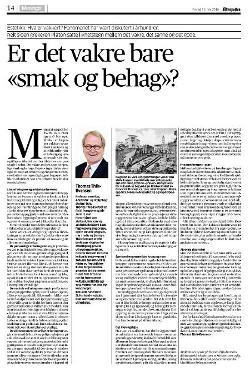 … Mellom boligblokkene på Enerhaugen ligger et upåaktet storverk i norsk arkitektur: St. Hallvard kirke og kloster, tegnet av Kjell Lund i 1966. Bygningens eksteriør er lukket, formet som en hvilende kube. Tung og urokkelig står den rett på grunnfjellet, veggene er i grov tegl, vinduene er små glugger og inngangene er kilt inn som dype snitt i massen. Interiøret er omsluttende i form av en sylinder, med varmrøde teglvegger som kretser om rommet som i en hule, der lyset siver inn gjennom smale vertikalsnitt i overflaten. Taket er synkende og faller som en knyttneve ned i rommet i form av en omvendt betongkuppel, men stiger så igjen til den ene siden i retning av alteret.
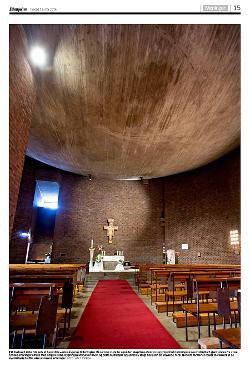 Alle disse trekkene er med på å tolke klosterets funksjon: Den lukkede kuben viser til munkenes avsondrethet fra utenverden, sylinderen til deres konsentrasjon om bønn og det synkende taket tolker himmelens tilstedeværelse, mens stigningen løfter blikket mot gudstjenestens fokus.